![[Image: How to have a successful block center]](https://www.pre-kpages.com/wp-content/uploads/2022/01/EEC34_wide.jpg)

Before we start, let me ask you a question: What’s in your block center?
If you’re looking for ways to spice up your block center or help your kids get the most out of the block center, then this episode is for you!
Because, let me tell you, when your block center is well-stocked and organized, student engagement will skyrocket!
But how do you make sure yours checks all the right boxes and is as successful as it can be?
Tune in to this episode to find out!
Ready? Let’s dive in!
Step #1: Choose the Right Materials
![[Image quote: "Remember that not everything in your block center has to come from the store."]](https://www.pre-kpages.com/wp-content/uploads/2022/01/EEC034_quote2.jpg)
Selecting your materials carefully is a must if you want your block center to be as successful as it can be. Below is a list of some of my favorite tools to use in a block center.
Wood Slices
The first thing I’d like you to consider when it comes to selecting materials for your block center is to think outside the box. I also want you to remember that not everything in your center has to come from the store.
For example, wood slices are inexpensive and fun to use. I purchased mine from Amazon. They’re a natural element you can keep in your block center. Plus, they can be used in many different ways. For example, my students love to use them to build spiral staircases.
However, keep in mind that if any of your students has a tree allergy, you’ll have to be careful with your wood slices.
Rocks and Sticks
Yes friends, rocks and sticks can be used in the block center. You can get them for pretty cheap from any craft store. The rocks I have are smooth and flat and the sticks are pretty easy to use. My students love building stuff with them such as bridges and staircases and all sorts of other cool things.
Plastic Shot Glasses
They might not be natural items, but plastic shot glasses can be a great addition to your block center. They’re great for building, stacking, and creating all kinds of fun stuff in the classroom.
Vehicles and Traffic Signs
I know that there’s a big push for natural objects in the classroom these days. But I tend to be a realist, and if we want things to last, then they have to be sturdy.
This is exactly why I like to use plastic vehicles and traffic signs — painted wooden ones tend to chip easily —.
They’re also super easy to clean, they can go into your dishwasher! I keep a box of them in my block center because the children really enjoy playing with them.
Labels
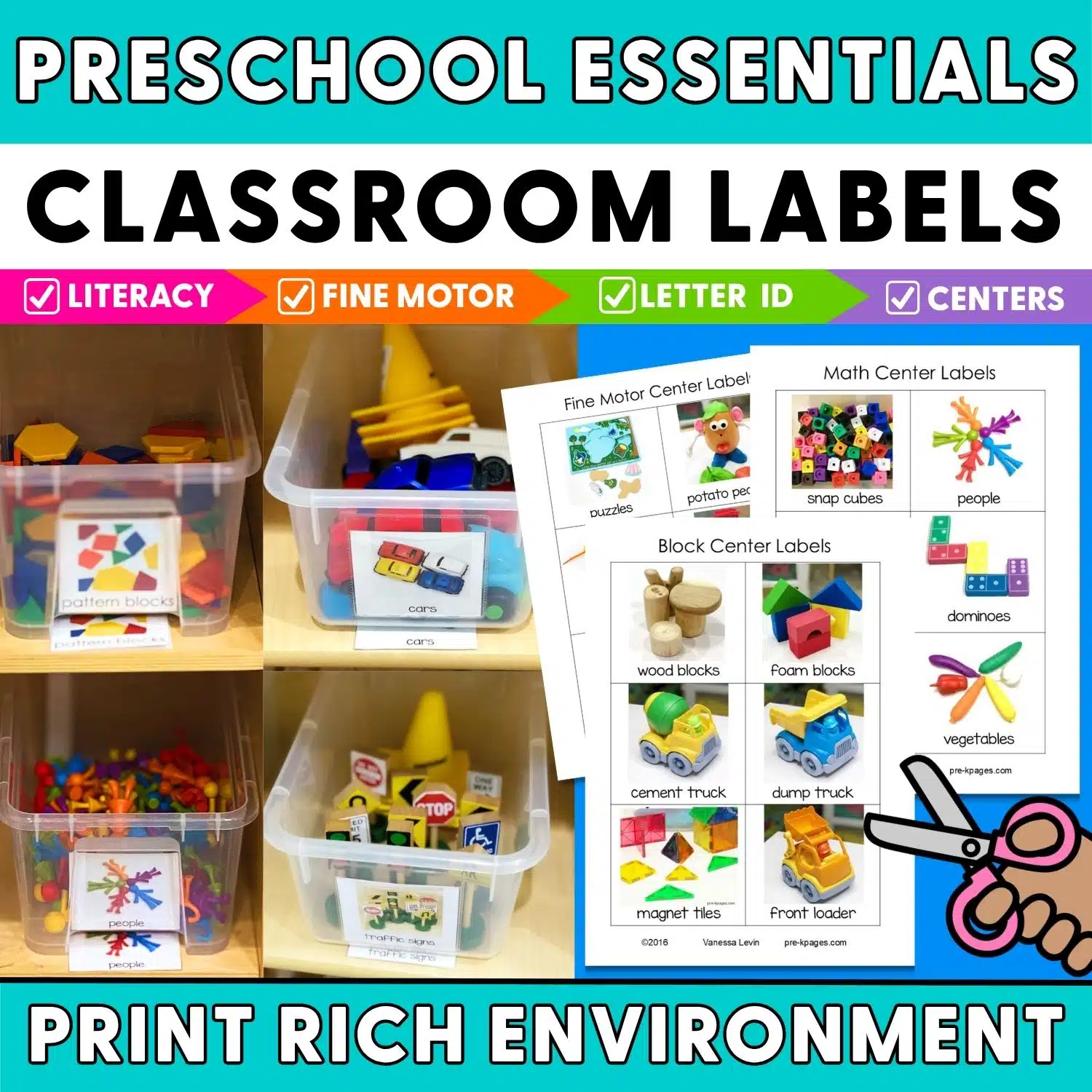
Labels are super important in a block center (or any center, really). Every tub used in my block center has a label. This helps my students know where each thing in the center goes.
People
No, I don’t mean real people, but small plastic people.
I remember when I first started teaching preschool, not every block center that I came across had people in it. But because I worked exclusively with dual language learners, I learned really quickly that small children will lend a voice to dolls.
And this is the main reason why I use people in my block center: They’re a great way to help my students develop their oral language skills.
Fake Leaves
Fake leaves are super fun to use in a block center. My students are always using them with the craft sticks and the rocks to build jungle habitats and whatnot.
Plus, because they’re fake, so they don’t brown or wither away, and they can withstand a lot of use, so they’re a great financial decision!
Blocks
Obviously, it wouldn’t be a block center if it didn’t have blocks.
What kind of blocks should you use?
Some programs may require you to use wooden blocks, and that’s okay. But when you have more than twenty children in a classroom by yourself, wooden blocks can quickly become a safety hazard.
And this is exactly why I use foam blocks! My students love them as much as real wooden blocks, plus, they’re much safer. And, friends, that is a win in my book!
Clipboards and Blank Paper
I know you’re thinking, “Vanessa, why on earth would I put that in the block center?” But let me tell you something: Children love a good clipboard — just as much as I do —.
The ones I have are half size and very easy to use. When my students build something in the block center and don’t want others to touch it, they can use a clipboard to make a sign that says “Don’t touch”.
They can also use them to create signs and blueprints, or write notes. They’re multi-use and fairly easy to take care of.
A Center Sign
Another thing that I always have in every center is a center sign. This serves two purposes: The pictures on the center signs are for the students, while the words are for the adults. The signs can be used to explain what the children are learning in the block center.
Books
Yes, a block center can and should have books in it. I love to add literacy to every center in my classroom, and this one is no exception.
I teach my students to use the books in the block center as reference. So, if for example they want to build something, and there’s a book about it in the center, I’ll tell them to look in there for information.
Step #2: All About Labels
Labels are important and they can make or break your cleanup time in the block center. Labels on both ends of tubs and shelves in the center make a world of difference.
Step #3: Complement Your Themes
![[Image quote: "Labels in your block center can make or break your cleanup time."]](https://www.pre-kpages.com/wp-content/uploads/2022/01/EEC034_quote3.jpg)
All the things I’ve stated above stay in the center all year long. But I don’t start off with them all on day one. Instead, I start putting things out slowly, one at a time. And then eventually, we build up to all the materials that I’ve already mentioned. And I make sure to add things to the center to complement the themes.
So for example, if we were doing a farm theme, I would make sure to put specific books about tractors and farm machinery and things like that in the block center.
Step #4: Make Sure to Have Enough Space
Since the block center is super high interest, you have to make sure that you have enough space for your students to spread out and really engage with it.
If your block center is too small, then children are going to be bumping into each other and their buildings are going to be knocked over more often. Sure, that might happen even if your block center has enough space, but if it happens excessively, then your center is not big enough.
Another thing to consider when it comes to setting up your block center is where it will be located. One of the things that I learned over the years is the importance of having my block center located close to my dramatic play center.
Why is that? Simply because they’re both high interest centers that can be very noisy, and you want to keep all that high energy and loud voices in one area.
Step #5: Manage Your Students
There is no one right or wrong way to manage students in the block center (or any center, really). Some early childhood programs don’t offer any other options; you must have free choice centers.
And I agree, free choice is the absolute best method for running centers. It offers children opportunities for problem solving, and there is nothing more motivating to a child than making their own choices.
Plus, there is no better way to support the development of problem solving skills in the early childhood classroom than letting children figure out how to share space and materials by themselves.
However, if you have more than twenty students in the classroom, and you don’t have an assistant, then you might have to do some crowd control.
I delve into all of this in more depth (and with more examples) in the video above, so make sure to watch it!