
All teachers should be lifelong learners. Professional development can be a challenge. Conferences and workshops are great but the expense can add up. Online courses or podcasts are good alternatives. But sometimes it’s difficult to invest a chunk of time at one sitting. Professional development books are great resources – affordable (especially if you check your local library) and easy to fit in your schedule (starting and stopping more easily). Sometimes you can even participate in an online book study. Check out these professional development books for preschool teachers.
Professional Development Books for Preschool Teachers
Reading books for preschool teachers can help you learn and grow at your own pace and in ways that support your personal schedule. Read a section of the book and jot down some notes or underline and annotate in your book. (But don’t write in a library book!)
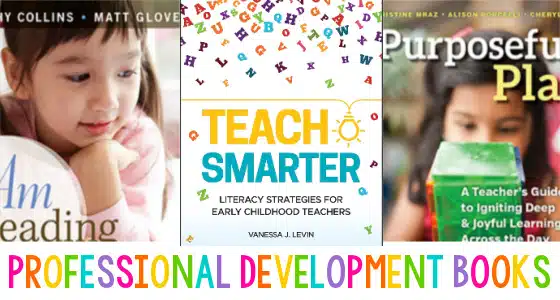
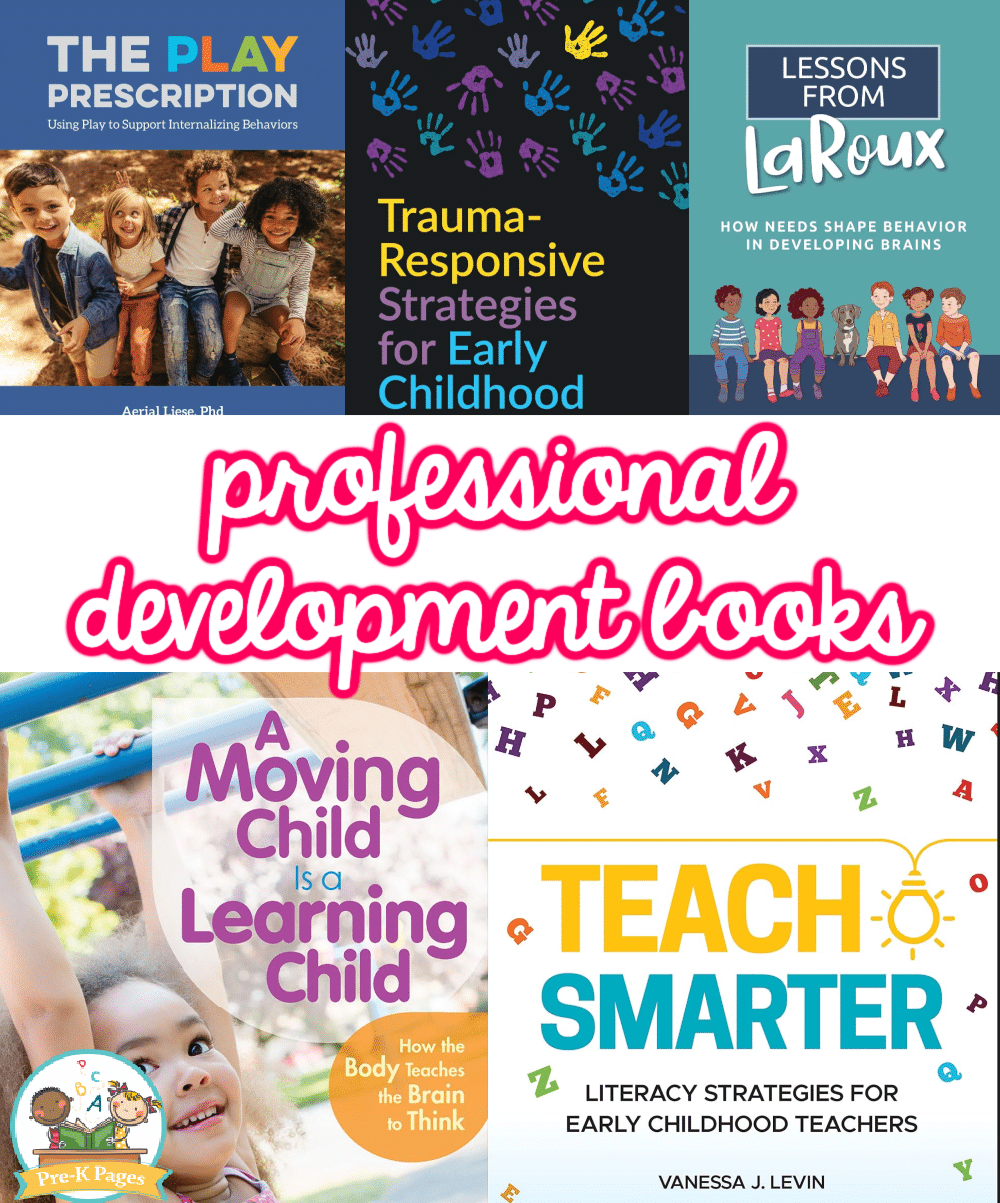
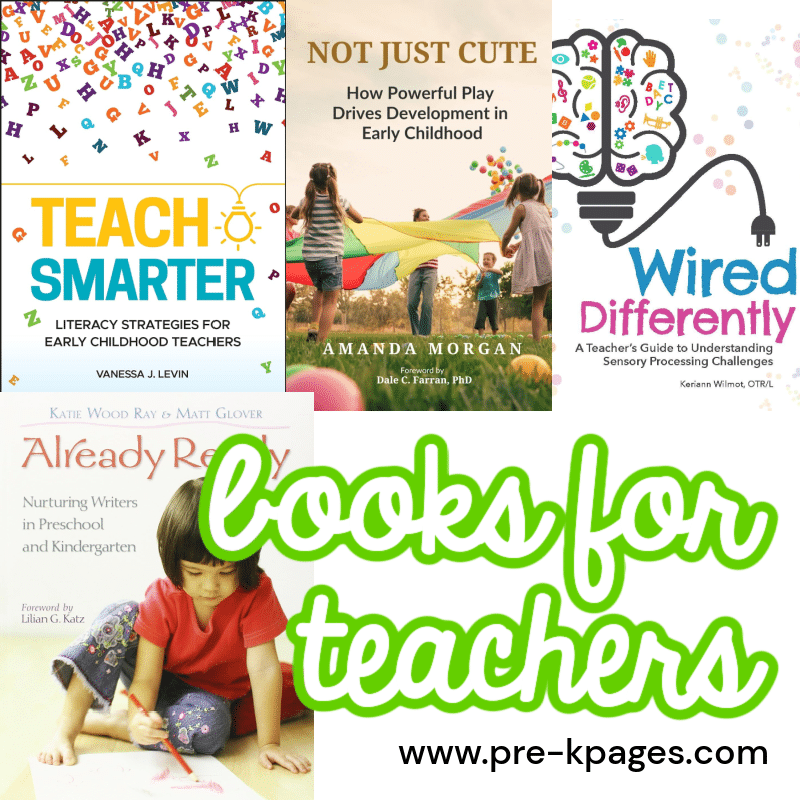
Teach Smarter: Literacy Strategies for Early Childhood Teachers by Vanessa Levin
This practical guide helps teachers infuse their lessons with vibrant and meaningful hands-on instruction that will not only engage students, but also help them build meaningful connections to both spoken and written language. You’ll discover how to create a strong literacy foundation in each one of your students and fully prepare them for success in kindergarten and beyond.
The Most Important Year: Pre-Kindergarten and the Future of Our Children, by Suzanne Bouffard
An eye-opening look inside pre-K in America and what it will take to give all children the best start in school possible.
Big Questions for Young Minds: Extending Children’s Thinking, by Janis Strasser, Lisa Mufson Bresson
What are “big” questions, and how do they encourage children to think deeply? With this intentional approach-rooted in Bloom’s Taxonomy-teachers working with children ages 3 through 6 will discover how to meet children at their individual developmental levels and stretch their thinking. A foundation for using higher-level questioning in preschool.
Not Just Cute: How Powerful Play Drives Development in Early Childhood by Amanda Morgan
Backed by research, Amanda Morgan shows why guided play is essential for high-quality early education. It’s not play vs learning; it’s play = learning. While based on research, the tone of the book makes complex concepts easy to understand and (more importantly) apply. Understand the why behind play and the how to do it in your classroom.
The Whole Brain Child by Daniel J. Siegel and Tina Payne Bryson
The authors explore the science of how a child’s brain is wired and how it matures. They offer twelve key age-appropriate strategies that foster healthy brain development, leading to calmer, happier children.
Tiny Humans, Big Emotions by Alyssa Blask Campbell and Lauren Elizabeth Stauble
Designed for all humans—tiny and big—this book shows caregivers of children how to handle challenging behaviors and outbursts while empowering them to recognize and manage difficult feelings like anger, sadness, and shame, along with anxiety.
The Play Prescription, by Aerial Liese
Anxiety, depression, and social withdrawal are real, and even young children ages 3-7 can suffer from them. Dr. Liese focuses on child development and emotional competence. She presents research-supported educational strategies for teachers to use in the classroom.
Early Childhood Professional Development Books for Teachers
Start a reading group with your colleagues or find a book club online. Talking about what you read and learn is a valuable strategy to remember and apply what you’re learning.
Lessons from LaRoux: How Needs Shape Behavior in Developing Brains by Dan St. Romain
Children’s behavior is communication—pointing adults to deeper needs and emotions. Understanding these deeper issues helps teachers know how to respond to the behaviors they see. Filled with lighthearted stories about adventures with his dog, LaRoux, St. Romain outlines fifteen needs of young developing brains and how adults can work to get the needs met in proactive ways so children don’t inadvertently do so through misbehavior.
Positive Behavior Principles by Dan St. Romain
Although behaviors in the school system have changed a great deal in the past few decades, our strategies for supporting those behaviors have not. When we move beyond punitive practices for dealing with misbehavior, we find strategies that work. This book outlines nine core principles that can be used to design prevention, intervention and crisis strategies for supporting student behaviors in schools.
Purposeful Play by Mraz, Porcelli, and Tyler
According to this book, play is serious business. Play can deepen learning and develop all kinds of skills. The authors offer many tools, lessons, and suggestions for bringing play into all areas of your learning classroom.
Conscious Discipline by Dr. Becky Bailey
Rethink classroom management and discover how to support social-emotional learning. Help children begin to develop self-regulation skills. This book is foundational to the Conscious Discipline approach to the classroom – and will help the teachers look inward as well as what they do in the classroom.
Trauma-Responsive Strategies for Early Childhood, by Katie Statman-Weil
Young children who have experienced trauma need support from teachers who understand how trauma can show up in the classroom and what they can do about it.
FLIP It! Transforming Challenging Behavior by Rachel Wagner
Discover FLIP IT‘s four simple steps for transforming challenging behavior in young children: F – Feelings, L – Limits, I – Inquiries, P – Prompts. Teachers and parents can help children learn about their feelings and gain self-control by using that mnemonic.
Books for Preschool and Pre-K Teachers
Think about the area you would like to improve in your classroom or the topic that interests you. As you read, think about how the information connects with your classroom or in your particular situation. Not everything in a book will directly apply but usually you can adapt what you read in ways that benefit your classroom.
A Moving Child Is a Learning Child: How the Body Teaches the Brain to Think by Gill Connell and Cheryl McCartney
Discover the active learning needs of young children and explore activities, games, and tips that will meet those needs and support development. Grounded in best practices and current research, this hands-on resource connects the dots that link brain activity, motor and sensory development, movement, and early learning.
Wired Differently by Keriann Wilmot
This book will help you to decode what may seem like everyday challenging behaviors. It’s possible that these children are struggling with sensory processing disorder (SPD). Understand what sensory processing disorder (SPD) is and how it can interfere with a child’s learning. Learn how to include sensory processing strategies as part of a typical classroom routine, and why they’re important for all children.
Already Ready, by Katie Wood Ray and Matt Glover
Young children are already writers, the authors of this book contend. They explore how to nurture the storytelling and writing abilities of preschoolers. Teachers can create an environment to support the young writers they already have.
I Am Reading, by Kathy Collins and Matt Glover
Reading behaviors start before young children can decode words on a page. Discover how to support emerging literacy skills and guide children to make meaning of text even if they cannot read the words.
The Read-Aloud Handbook by Jim Trelease
Why should we read aloud to children? This book covers the importance, benefits, and research about reading aloud. You will also discover strategies and techniques for reading and for supporting children in their literacy development.
What books are you reading? What books have helped you as a preschool teacher?
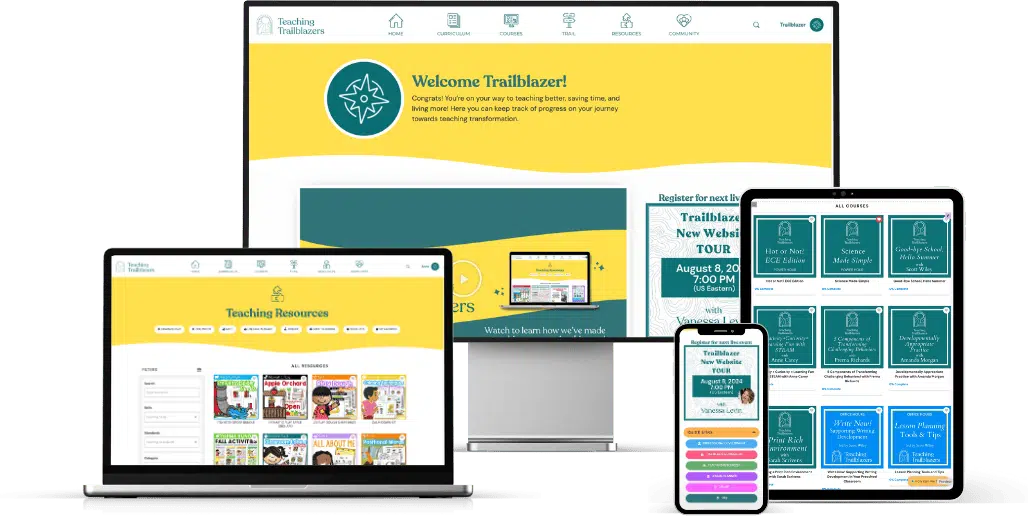
Simplify Your Day, Energize Your Teaching, and Reach Every Learner
Sound impossible, doesn't it? Not if you have Teaching Trailblazers in your teacher toolkit!
Teaching Trailblazers is the #1 program for Preschool, Pre-K, & Kindergarten teachers that helps you teach better, save time, and live more. Inside you'll find everything you need to make teaching easier!
- Curriculum: A full year’s worth of curriculum + done-for-you printables…use them as a standalone program OR supplement your existing curriculum! Includes the ENTIRE play- and research-based curriculum from Pre-K Pages!
- Professional Development: Access a growing library of on-demand training sessions on hot topics like classroom management, behavior, social-emotional learning, and more.
- Community: Experience our caring community of supportive Early Childhood professionals and expert mentors. You’ll be surrounded by others you can count on to help, inspire, and empower you to be the best educator you can be!

On average, teachers spend an average of 105 hours outside of their required working hours per month. But you don't have to...
Join Vanessa Levin, a 20+ year veteran pre-k teacher, as she helps you navigate the challenges you face in the classroom every day. From literacy to social emotional learning and more, Trailblazers gives you the support you need!