
Read-aloud is an important part of early literacy for children, but when do you begin (and end) read-aloud?

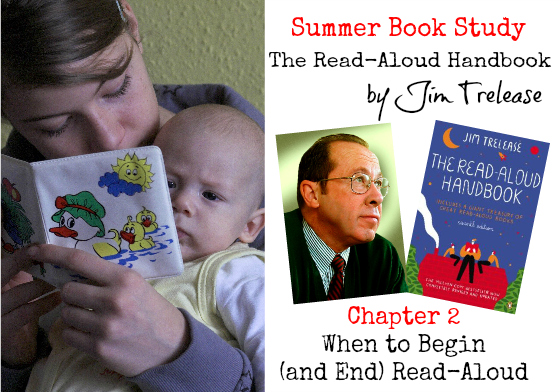
Today we’re discussing chapter 2 of The Read-Aloud Handbook (7th edition) by Jim Trelease; When to Begin (and End) Read-Aloud.
I hope you enjoyed chapter 1 with Scott over at Brick by Brick. I am thrilled to pieces that I get to host this chapter because Jim touches on some very important, hot-button issues in the read-aloud realm. I know, you’re thinking “There are hot-button issues about read-aloud?” You betcha! Keep reading to find out what they are.
When to Begin Reading Aloud for Childhood Literacy
In response to the question when to begin read aloud Jim answers with a question of his own, “When did you start talking to the child?” Of course, this makes perfect sense to us as actively involved parents and teachers of young children; we already know the importance of reading aloud to children from birth. However, the sad reality is that some parents do not understand this simple fact. For some reason they have not received this important message, therefore it is our job- no, our duty as educators to spread the word.
As a teacher, I have always believed in reading to kids as part of the parent’s responsibility each night in our partnership to educate their child. But I learned very early on that just telling parents to do so without an explanation as to why or a demonstration of how to do it was ineffective. You may be thinking an explanation or demonstration is overkill but allow me to share the story of Cherise. Cherise was a bright-eyed, curious little girl in my class several years ago -emphasis on the several portion. Her mother confided in me during a parent conference that she had given up on my request that parents read with their child each night. I asked why she felt she could no longer do so and her reply was this, “I give her the book and she can’t read it, she sits there forever trying to read but it’s hurting her self-esteem too much.” Needless to say I was astounded that anybody could misinterpret my request to “read with their child” each night in such a way. The child in question was four years old. Of course, I asked Cherise to pick out her favorite book from the classroom library and we did a quick demonstration of how to read-aloud to a young child. From then on a Family Literacy Night was implemented, live and learn.
Reading Aloud to Babies In Utero
Jim also goes on to cite some fascinating research about reading to your baby in utero proving it’s never too early. Start planning those board book baby showers that are all the craze on Pinterest now!
Reading Aloud to Children with Special Needs
Many of our readers are Special Ed teachers or parents of children with special needs. Regardless of your vocation or situation you will definitely find Jim’s story about Cushla and Jennifer heartwarming and inspiring- tissue alert!
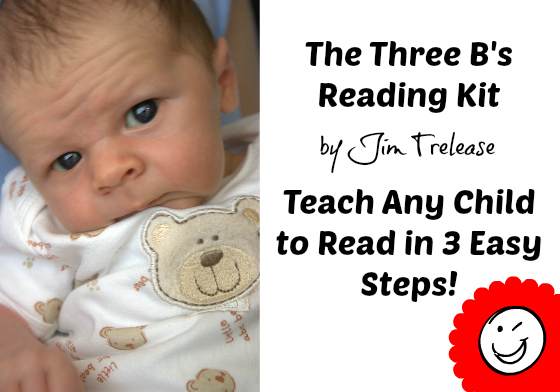
Are you ready for the hot-button issue? Here it is!
One of the most frequent questions I am asked by parents and teachers alike is this “Can I buy something to teach my child (or students) to read?” And apparently Jim gets this question quite often too. I laughed out loud when I read Jim’s reply about the types of things we have that are instant and how reading isn’t one of them- that’s my summary, you’ll have to read the book for the real and much funnier quote.
He also lays out his carefully crafted and highly effective “reading kit” consisting of three B’s- where I also lol’d again, is it just me? Please tell me you’re laughing as you read along too so I don’t feel like a nutcase! This section of chapter 2 really resonated with me as an early fluent reader- you can read all about my personal reading journey over at TeachMama.
When to Stop Reading Aloud
Jim makes a very compelling argument about reading aloud to kids well beyond their early years. He says “…kids usually listen on a higher level than they read.” I know many parents who read the Harry Potter series aloud with their older children. As teachers it’s important to not give up reading aloud in the upper grades. One of my fondest memories of elementary school was my fourth grade teacher reading aloud to us daily.
There’s a lot more to this hefty chapter, I have only touched on the highlights. I invite you to share your thoughts or personal stories about when to start and end read aloud in the comments below or link up using the linky. Happy Reading and stay tuned for chapter 3 which will be hosted by Karen over at Prekinders on July 15.
Check out the links below for more discussion about The Read-Aloud Handbook by Jim Trelease.