

Didn’t Matt and Eilis do a great job with chapters 10, 11, and 12? I’m back today to continue our Literacy Beginnings book study blog party with Chapters 13 and 14. I’ve combined these two chapters because one was super short and the other was long.
In Chapter 13: Developing Early Reading Behaviors in Shared and Independent Reading we explore the different ways in which young children demonstrate their understanding of “reading”. Below are the reading behaviors that most of my students need to be explicitly taught.
- Start at the front of the book
- Turn each page gently by the corner
- Turn the pages right to left
- Look at every page
- Use the pictures to tell a story

Here are some ways I help teach the skills above:
- Use a big book to demonstrate each skill to the whole group
- “Talk Through”- as I read the story I talk about what I am doing, “I’m going to turn the page by the corner now.”
- Play “Pass the Book” Game: Gather the students in a circle; select a book and demonstrate the skill you want them to learn such as locating the front and back cover, turning the page etc. Talk through your demonstration by saying “This is the front of the book, this is the back…” Next, pass the book around the circle and have each child demonstrate for the class.
- Practice concepts of print throughout the day, not just literacy time
What are some ways you teach these early reading skills?
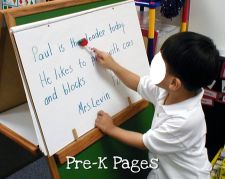
Reading left to right, return sweep, and establishing a voice-print match are other skills the authors address in Chapter 13. The pocket charts Eilis shared in her review of Chapter 12 are perfect for practicing all of these skills. Fun pointers and props can be used to motivate young readers learning these skills for the first time.
What types of fun pointers have you found or made?

The following are some ways teachers can support reading development:
- Provide opportunities daily for students to explore and interact with print in fun and meaningful ways
- Use specific language to help children develop early reading behaviors
The information in Chapter 14: Learning to Read will be familiar to most kindergarten and first grade teachers. The authors list all the complex skills that constitute the reading process, then break them down and explain why they are important.
- Think About the Text
- Think Beyond the Text
- Think Within the Text
Don’t let this chapter daunt you, as you read you will begin to realize how much of what you already do is supporting literacy development.
To be an effective, fluent reader, all of the (reading) behaviors must be in place. (Ch. 14 p. 139)
If any of these crucial literacy skills are not developed it can lead to difficulty later on. Therefore we must be very intentional in the planning and crafting of our lessons. The authors have a great three page transcript of a discussion that happens in the classroom during and after a read aloud. The transcript helps illustrate their points because it also includes an analysis of what the teacher says and how the students respond- fascinating!
What are your thoughts on Chapters 13 and 14? Leave a comment below! If you write a response on your blog, be sure to link up to the Linky party below.
Are you tuning in late? No worries! Matt from Look at My Happy Rainbow has graciously started a guide with links to all the chapters! Not sure what’s going on? Check out the Literacy Beginnings FAQ for answers.
Chapter 15 will be hosted by Leslie from No More Worksheets so stay tuned!
Want to let your friends know about the book study blog party? Click “Like” at the top of this page or choose from other social media options below.