
The Literacy Beginnings book study blog party is in full swing and we’re back today with Chapter 6: The Critical Role of Language and Learning.
It’s so hot here I wish I could dive into the ocean, but I’m in Dallas so instead I’m diving into this book! Insert cliche about eggs and sidewalks here.
“Language plays an extremely important role in young children’s learning.” (Ch. 6 pg. 81)
There are many ways which we as early childhood educators can support the oral language development of our students.
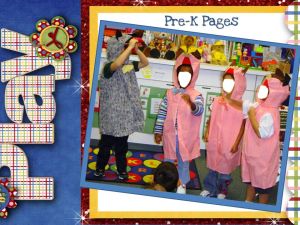
One of the ways I support oral language development in my classroom is by acting out familiar stories. We study each fairy tale for one week, focusing on a different version each day. We also do this for each nursery rhyme. On the last day of each fairy tale or rhyme we act it out. Above you can see my students acting out The Three Little Pigs. The costumes were purchased so long ago I have forgotten where they came from but you can easily make simple headbands out of sentence strips .
.
The oral language benefits of acting out familiar stories {familiar is the key} are tremendous. Acting out stories is highly motivating for young children, who doesn’t want to be the wolf? Everybody wants a turn to wear the headbands or costumes and say the lines that have become so familiar to them. When we focus on one story or rhyme for a week it provides a scaffold for young children and they can then “retell” that particular story or rhyme with ease, it’s like a dear friend to them. They begin to make connections between new books and their favorites we have studied. When I hear statements like “That is just like the sheep Mary had!” or “Sri fell down outside just like Jack!” I realize the power and value of nursery rhymes and fairy tales. Oh, and just in case you are wondering I do change the end of Little Red Riding Hood!
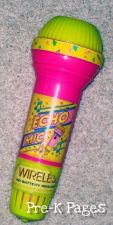
I work with ELL or Second Language Learners so I tweaked our plays to make sure they were able to fully participate. We act out the story several times to give everybody a chance to participate, the first time we act it out I am the narrator- this gives my ELLs a language model to follow. In the next re-enactment I give the job of narrator to a student. I also have the narrator talk into a plastic microphone from the dollar store to make the job more attractive. The children decide when they want to have a turn to act out the story; it’s important not to force your ELLs to speak. If I have a student who won’t speak I have the audience chime in with his or her lines, they love to help!
What types of activities do you use in your classroom to support oral language development?
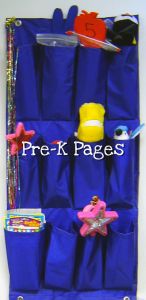
Another way to support oral language is through the use of props and puppets. I think one of the best things that ever happened to me as a teacher was when the Beanie Baby market collapsed! All of a sudden you could find all sorts of great props for a quarter or less at garage sales and thrift stores. If you cut a hole in the bottom and take out all the beans (they’re not really beans, but what are they?) you can turn them into puppets or put them on a stick to create pointers. If you start collecting too many {I can’t help it- it’s a disease!} you can store them in shoe pocket organizers for quick access. Above you can see my shoe organizer where I store many of my props, puppets, pointers, and Beanies.
I want to know what tips do you have for making puppets or props?
Conventions of Language
While oral language is important, so are the rules of language. The authors provide a list of conversational rules both 3 and 4 year olds can begin to learn. To some this list may seem challenging but when you provide daily opportunities to practice skills like looking at the speaker, responding to the topic, and asking questions you will see great growth. These skills need not be taught in isolation, they occur naturally and can be easily woven into your existing schedule.
I think one of the most challenging skills on the list is asking questions, this is difficult for all young children and especially those who are learning English as a second language. One of the activities I use to support this skill is the “microphone game.” We take turns asking and answering simple questions using a plastic microphone {are you sensing a dollar store theme here?}, you can read more about this activity here.
How do you help your students understand the difference between making a statement and asking a question? If I had a nickel for every time a child said “I have a puppy” when the topic is not puppies I’d be rich! But those situations are what make teaching pre-k and kindergarten unique and fun.
What are your thoughts on Chapter 6? Leave a comment below! If you write a response on your blog, be sure to link up to the Linky party below.
Are you tuning in late? No worries! You can catch up on past chapters here:
- Chapter 1 @ Pre-K Pages
- Chapter 2 at Teach Preschool
- Chapter 3 at Brick by Brick
- Chapter 4 at Prekinders
- Chapter 5 at Pre-K Pages
Don’t forget to check out the fantastic responses to these chapters listed in the linky below.
Chapter 7: Developing Strong Oral Vocabularies will be hosted by Scott at Brick by Brick so stay tuned!
Want to let your friends know about the book study blog party? Click “Like” at the top of this page or choose from other social media options below.