



There are some things that will make or break you as a teacher, and transitions are right there at the top of the list for early childhood teachers.
Every single day is full of transitions in preschool, so having a surefire list of tips that’ll help you make them as easy as possible is crucial.
Lucky for you, I’m about to share those tips with you.
So, if you’re struggling with transitioning from one activity (or place) to another in your preschool classroom, this episode is for you!
Want to learn more?
Keep reading!
Quick Story Time
![[Image quote: “There are so many transitions that happen every single day [in the preschool classroom].” - Vanessa Levin]](https://www.pre-kpages.com/wp-content/uploads/2022/08/EEC063_quote1.png)
There are a lot of transitions that happen daily in preschool, and that can make avoiding chaos feel like an impossible task. Especially in the beginning of the school year.
If you don’t have all your transitions planned out and ready to roll on the first day of school, then you’re going to be teaching harder, instead of smarter. And that’s not what we’re striving for, right?
Don’t believe me?
Well, I’ve got a story for you.
My first year in public education, I was teaching preschool in Houston, Texas. The school where I was working was an “open-concept” school; it had no interior walls.
That meant we had four pre-k classes in one large “pod,” we all shared the same space.
We even had our own bathrooms and a door to the outside that students used to enter and exit the classroom during arrival and dismissal. And that meant that getting the kids in and out of the building was a breeze.
During center time, all four classes shared the center space as well.
Our students didn’t eat meals at school or go to specials, so we didn’t leave our pod except to go to the playground, which was right outside our door.
As you’ve probably already guessed, I rarely had a difficult transition that year, because we had so few transitions.
There were only four of them in our daily schedule: entering the classroom, going to centers, going to recess, and going home.
So transitions weren’t really a problem.
It was only when I moved to a school district where I had my own classroom with four walls that it became challenging, because we had to transition in and out of the classroom all day.
And that’s when I discovered that the fewer the transitions, the fewer the behavioral fires that I had to put out daily.
Transition Tips and Tricks
![[Image quote: “I like to think of transitions as the bridges in the classroom that connect one activity to the next.” - Vanessa Levin]](https://www.pre-kpages.com/wp-content/uploads/2022/08/EEC063_quote3.png)
How do some teachers make transitions look so effortless? And more importantly, how can you make it effortless?
Keep reading to find out the answer!
Tip #1: Create a Daily Schedule
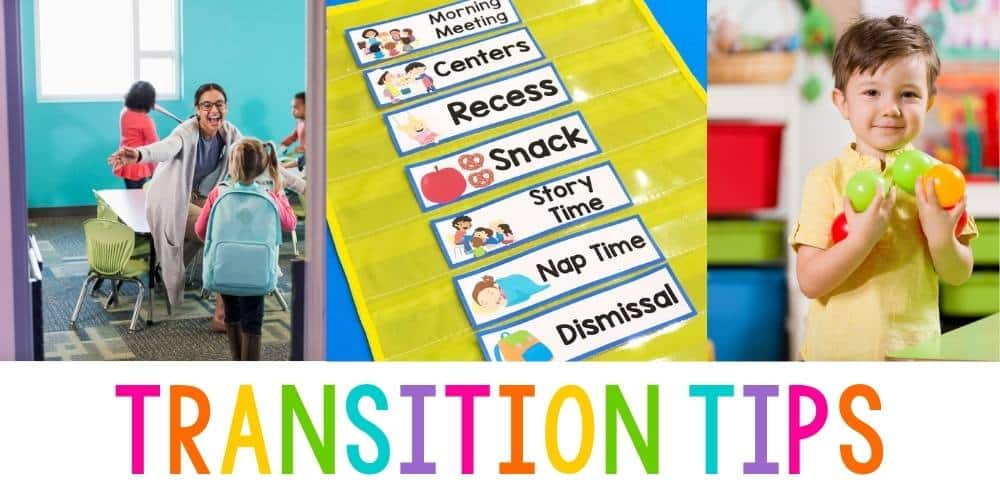
A daily schedule that follows a predictable routine is a must.
Why? Simply because young children have an innate need to feel safe and not knowing what comes next in their day can make them feel the exact opposite.
An inconsistent routine with too many changes to the daily schedule will easily overwhelm young children, especially in the beginning of the year.
The result? Students who act out.
So having a predictable routine each day can help your transitions flow more smoothly.

Tip #2: Reduce the Number of Daily Transitions
Young children can only handle so many transitions throughout the day.-
If you have too many transitions in your day, your students may become overwhelmed by the constant change.
And the way they’ll show that overwhelm is by acting out.
The general rule of thumb when it comes to transitions is no more than five per day. But if you do teach in a full-day program, you may need to have just a few more than that.
So, count how many transitions you currently have and try to reduce that number.
Tip#3: Keep Your Transitions Short
If your transitions drag on for too long, you’ll end up losing your students’ interest. Remember, young children have short attention spans, and they aren’t great at waiting for anything!
So, always be sure your transitions can get kids moving from one place to another quickly!
Tip #4: Set Clear Expectations
Make sure to set your expectations for transitions clearly so your young students can understand what’s needed of them.
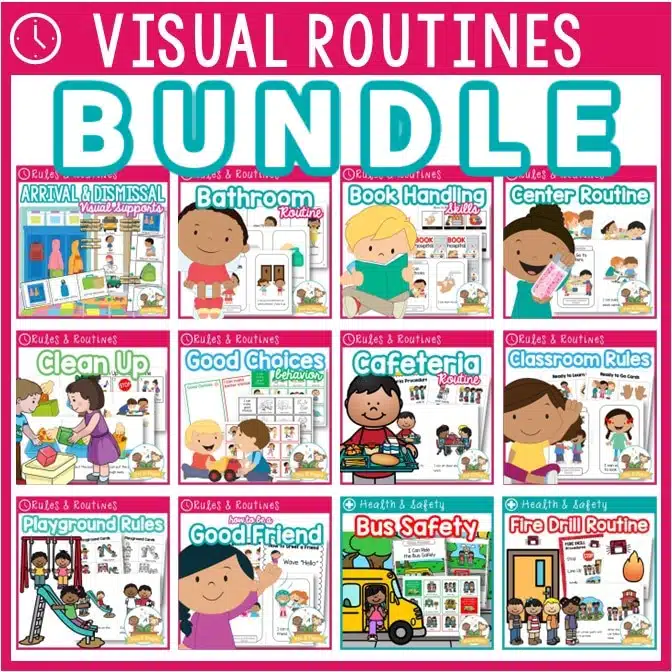
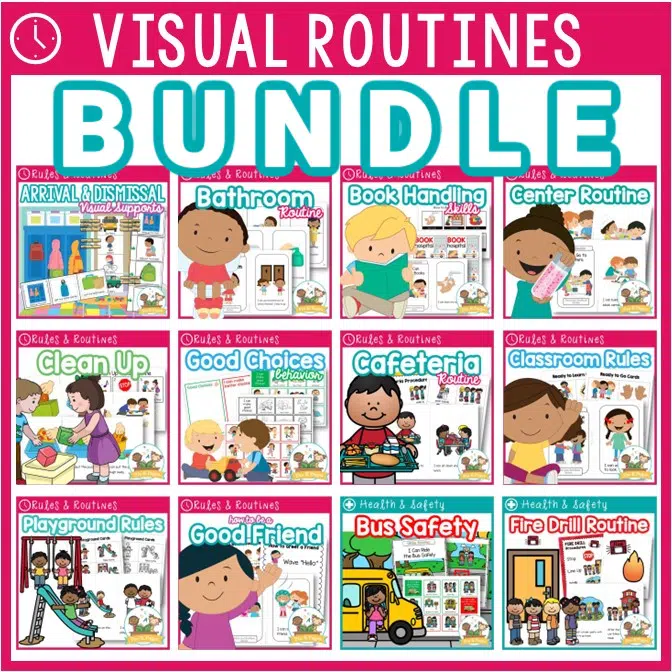
There are many ways to do that. You can use picture cues and visual supports, provide individual support for students who need extra help, or even role play transitions.
I discuss all my transition tips in more depth in the episode above, so make sure to give it a listen!
Links Mentioned in this Episode:
Grab our FREE Printable Daily Schedule