


Today, we’re diving deep into why you don’t need fine motor journals and what you can do instead.
We’ll cover these three topics:
- The developmental stages of writing
- Proper letter formation
- Authentic opportunities for developing fine motor skills
Plus, I’ll answer some of your burning questions at the end of this post, keep reading!
What Are Fine Motor Journals?
Fine motor journals are essentially notebooks that some teachers use to keep track of their student’s fine motor skill development using things like stickers, tape, and tearing paper.
I’ll be honest with you, when fine motor journals first appeared on the early childhood scene several years ago, every fiber in my being screamed, “NO, NO, NO!”
I mean, since when did fine motor skills and occupational therapy techniques take precedence over child development? Who’s steering this ship?
Here’s the bottom line: Fine motor journals are a handwriting fad, not a best practice. They are artificial, not authentic ways to develop these skills. My motto is, “Flat is boring, 3-D is fun,” and fine motor journals are as flat as it gets.

Handwriting vs. Writing
So, let’s start with the developmental stages of writing. Here’s the thing: There’s a huge difference between handwriting and writing – they’re not the same!
Handwriting is forming the letters of the alphabet correctly, from the top down. Writing is putting your own thoughts and ideas on paper.
The only prerequisite for children to draw or write authentically is that they have access to paper and writing tools like crayons and pencils. Period. Full Stop.
In her book, Already Ready, author Katie Wood Ray says young children are ready to write their thoughts for real reasons. Why would we want them to wait?
That’s ignoring child development. It’s like teaching children to identify uppercase letters first, then lowercase, then the sounds the letters make. Young children’s brains don’t work in a linear way.
And to take a quote from my book, Teach Smarter: Literacy Strategies for Early Childhood Teachers,”When we don’t teach the way children learn, we’re setting them up for failure.”
Stages of Writing: Ages 2-3 Years
The developmental stages of writing vary greatly among children, so a one-size-fits-all approach may not be effective. Some children may not be ready for the activities in fine motor journals, while others may find them too easy and not challenging enough.
Here’s a brief look at the typical developmental stages of writing for preschoolers ages 3-5:
Scribbling (Ages 2-3)
Makes random marks and lines without any specific shapes or forms. The child might scribble in a left-to-right motion or randomly across the page – think tornado writing.
This stage represents the child’s early attempts to communicate through writing.
Controlled Scribbling (Ages 3-4)
At this stage the scribbles become more controlled. Children might begin to mimic writing by making zigzaggy lines or loops.
Children begin to to understand that writing is a form of communication. They may tell stories about their scribbles, showing the beginning of narrative skills.
Mock Letters (Ages 3-4)
Children produce letter-like forms that resemble actual letters but are not yet true letters. These mock letters often consist of familiar shapes such as circles and lines.
Children recognize letters have distinct shapes and they use those shapes when writing at this stage. They begin to understand that letters are a part of writing words.
Stages of Writing: Ages 4-5 Years
Letter Strings (Ages 4-5)
Strings of random letters or letter-like shapes. Children often string together a series of letters without spacing and with little regard for actual words.
Children are experimenting with letters and beginning to understand that letters can form words. This stage is crucial for developing letter recognition and familiarity with the alphabet.

Transitional Writing (Ages 4-5)
Children start writing letters that are more recognizable and may attempt to write familiar words.
This stage shows children are developing an understanding of the relationship between sounds and letters (phonemic awareness). They begin to grasp that writing represents spoken language.
Finally, you’ll begin to see Conventional Writing in children ages 5 and up.

Proper Letter Formation
It’s true, forming the letters of alphabet correctly is important, but this can be achieved through a variety of activities that don’t necessarily require a fine motor journal. For example, practicing writing letters in sand or shaving cream can be just as effective.
I’ve heard the argument, “How will they learn proper letter formation if I don’t use fine motor journals?” The answer? Through modeling and reinforcing daily!
Modeling during the morning message is key. Reinforce with letter formation songs.
I love the alphabet songs from HeidiSongs. These songs teach uppercase, lowercase, and letter sounds all at once. You’ll be surprised how many of your students will start singing these songs while writing.
Infuse your classroom with authentic opportunities for writing. Have paper and clipboards in your blocks and dramatic play centers. Encourage writing/drawing observations and data collection in the science center. And of course, there are many ways to support writing in your writing and or art center.
For example, when kids are “writing” an order in the dramatic play center, you don’t stop them because they haven’t learned to write the letters correctly yet, right? That would be ridiculous!
Authentic Fine Motor Activities
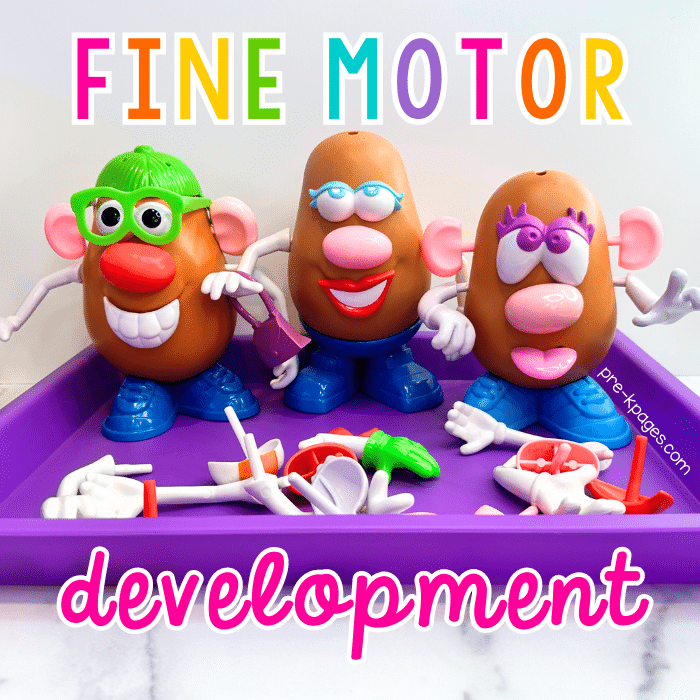
Finally, let’s talk about authentic opportunities for developing fine motor skills. Aside from fine motor journals, there are countless ways for your students to use stickers, hole punches, scissors, or tear tape in your classroom.
Look at your daily schedule and evaluate all the authentic opportunities for your kids to develop fine motor skills:
- Play dough
- Sensory bins
- Hole punch
- Manipulating puzzle pieces
- Stringing beads
- Squeezing liquid glue
- … and even Potato Heads
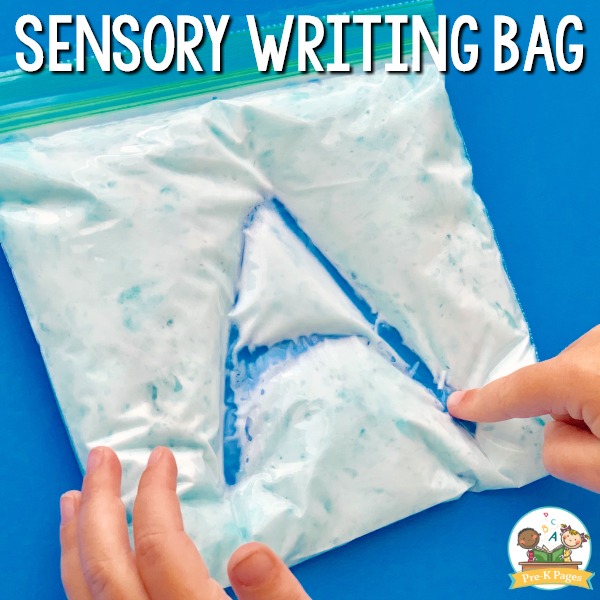
Activities like writing letters in sand or shaving cream can also be just as effective.
These activities not only help with fine motor skills but also provide a more meaningful and engaging experience for children. These are much more developmentally appropriate than flat fine motor journals. We want young children to learn through play and hands-on experiences, because research shows that it’s how they learn best.

Questions About Not Using Fine Motor Journals
Now, let’s get to some of your burning questions!
“They can write or draw freely in the writing center, so fine motor journals can’t hurt, right?”
Newsflash! A little bit of something artificial is not okay. We should avoid activities that waste valuable classroom time. Instead, we should focus on more valuable opportunities for authentic learning.
“How will I keep track of students’ fine motor progress if I don’t use fine motor journals?”
That’s what student portfolios are for. You can use an envelope for documenting tearing and cutting skills. Just place the torn paper or cutting samples into an envelope, label with the child’s name and date, and place in their portfolio.
“I do fine motor journals because my kids love them.”
Sure, kids love candy and soda too. Just because they like it doesn’t mean it’s good for them. If you asked them if they’d rather do a fine motor journal or play in a sensory bin, which do you think they’d choose?
“How will they be ready for kindergarten if I don’t do fine motor journals?”
If we had to rank what kindergarten teachers look for on the first day of school, #1 would be to sit and listen to a story, #2 would be following directions. Sure, fine motor skills are important, but they don’t rank as high on the list.
As the saying goes, “You have to Maslow before you can Bloom!” Let’s not lose sight of the children in front of us and their current needs.
There are plenty of alternative ways to develop fine motor skills that may be more effective and engaging than fine motor journals. So don’t feel pressured to use fine motor journals, focus on child development first.