

Preschoolers love to explore and discover the world around them. In fact, they are born scientists–testing and experimenting and making conclusions. Preschool science experiments are easy to do at home and in the classroom. Often you can use things you already have on hand. And you can help preschoolers begin to think about how things work and why things happen as they do. Check out these easy science experiments for your kids.
Wacky Water Science Experiments
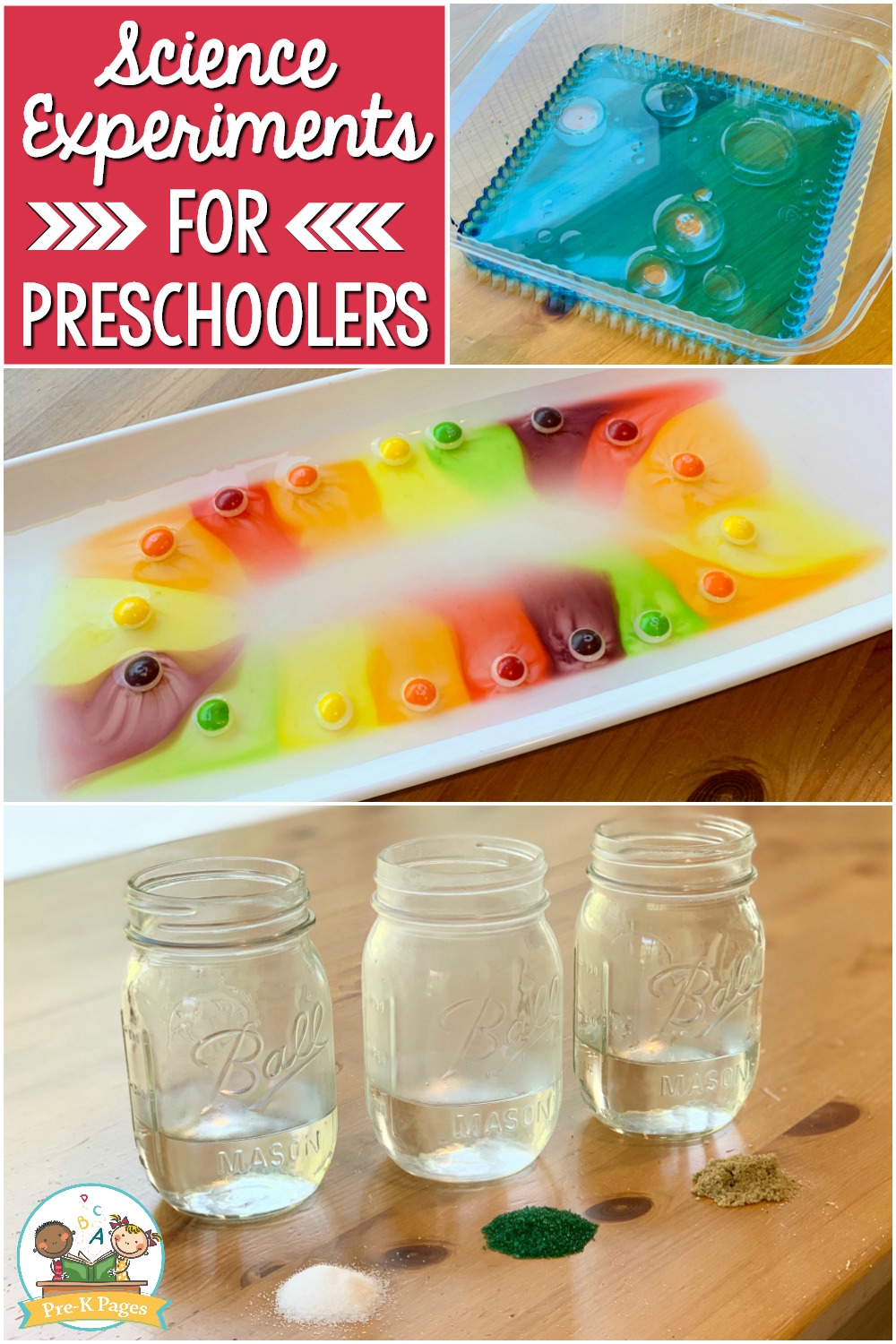
What material can be added to any lesson to grasp the interest of a preschooler? Water! Young children love safe water play of any kind. There are also a variety of basic facts to learn about water. These three easy water experiments that can serve as a boost to a unit of study or a fun day learning at home. By the end of this lesson, students will begin to understand science vocabulary such as dissolve, solubility, and density. Gather some simple materials to make learning a splash!
Easy Science Experiments Resources
- a pitcher of water
- 3 clear glass jars
- 3 different powders (examples: salt, sand, gelatin powder)
- stir sticks
- a plastic tray
- baby oil
- food coloring
- eye dropper
- white plates
- Skittles fruit candy
Experiments: Does This Dissolve?
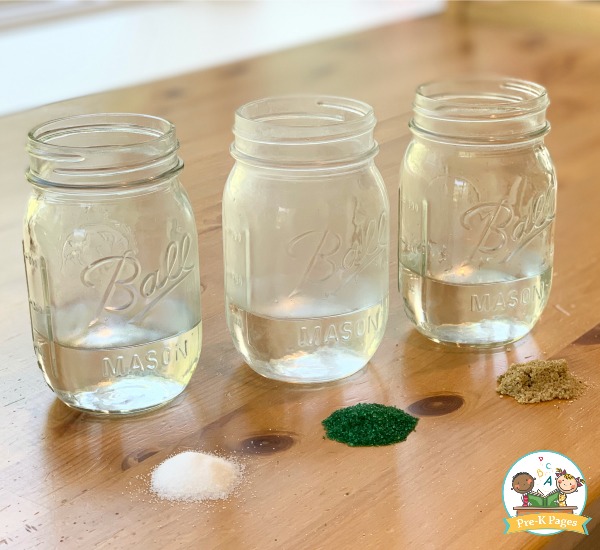
Using the pitcher, pour a small amount of water (a cup or two) into each clear jar.
Invite a student to pour a soluble powder, such as salt, into the first jar of water. Another little scientist can then slowly mix the powder using a stir stick.
Ask students what they notice about the powder. Students may offer observations such as, “the salt disappears” or “goes away.” Introduce the vocabulary word “dissolve” and explains what it means. (When something dissolves, it mixes in water or another liquid and you cannot see it anymore; it has all mixed in the water.)
Repeat the same steps using two other powders, such as sand and gelatin powder. Students will notice that the sand does not dissolve, and the gelatin powder does.
As an extension, you can introduce any of the following vocabulary words to older preschoolers:
- soluble: will dissolve in water – salt is soluble.
- insoluble: will not dissolve in water – sand is insoluble.
- solution: mixture made when one material dissolves another – salt water is a solution.
- solvent: material that dissolves another one – water is a solvent.
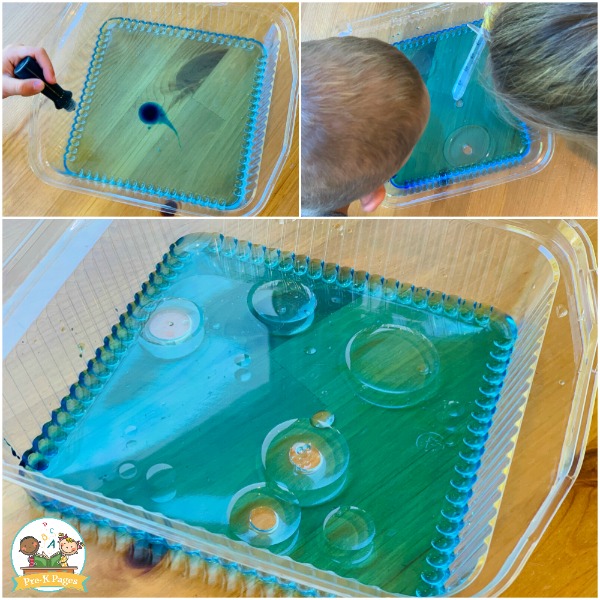
Experiment: Oil and Water
Pour a small amount of water onto the tray. Add a few drops of food coloring for an extra element of fun!
Invite students to take turns adding a few drops of baby oil to the water via an eye dropper. Ask students what they notice about the oil. They may observe that the oil “doesn’t mix” with the water, or that the oil “looks like beads.”
Encourage your young scientists to make guesses as to why this happens. Then, explain the meaning of density. (Density is similar to how heavy something is.) Tell preschoolers that the oil does not mix with water because the oil is less dense; the oil “floats” on the water.
As an extension, students can make their own oil and water bottles by combining both liquids in an empty plastic bottle. They can choose their own food coloring to make it their own, and add other materials, such as glitter! (More about discovery bottles)
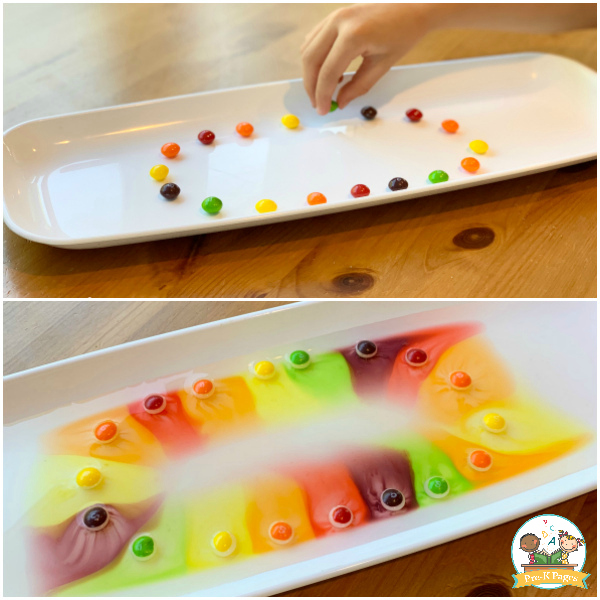
Experiment: Skittle Rainbow
This experiment is perhaps the most engaging! Invite students line up Skittles Fruit Candy inside a plastic plate. Allow them the freedom to be creative with their designs and color choices.
Once they have finalized their arrangement, students can slowly pour water over their candies.
Ask students to share their observations aloud. They will notice that the water takes on the color of the candy. Connect this activity to the dissolving activity. Remind them that some materials dissolve in water. What have they discovered about the Skittles candy? These colorful candies must be made of ingredients that dissolve in water! (Parts of the Skittles candies are soluable!)
As an extension, complete the same experiment with other candies, such as M&Ms or gummies. Which tasty treats are made of ingredients that dissolve in water?
Water Science Wow!
These hands-on activities lead students through the steps of the scientific method while experimenting with a material they use every day – water! Through teacher questions and prompts, students are asked to make predictions, pose hypotheses, and discover conclusions. The experiments can be completed consecutively within one lesson or spread throughout a liquids unit. Your little scientists will swim away from each lesson with new knowledge in their tanks!
Contributed by Lindsey Schwartz
More Science Ideas