Calendar time tips for Pre-K Teachers

How to Teach Calendar to Preschoolers
In the Pre-K or Preschool classroom, calendar time can be challenging for many reasons.
Sitting still and listening isn’t something that comes naturally to many children.
The ideal calendar time is very short, to match the attention spans of young children – no more than 2-3 minutes per year of their age.
Activities you do during this time are balanced and alternate between active and passive.
Calendar Time Activities
Here’s a sequence of calendar time activities you may consider:
- Transition to calendar time using a picture schedule as a visual cue.
- Sing a good morning song that includes movement.
- Attendance graphing activity.
- Sing – Invite children to choose a favorite song that includes movement.
- Calendar (this linear calendar is my favorite)
- Sing another song with movement
- Read aloud (see more than 40 book lists)
- Transition to the next activity using the picture schedule

Classroom Calendar Helpers
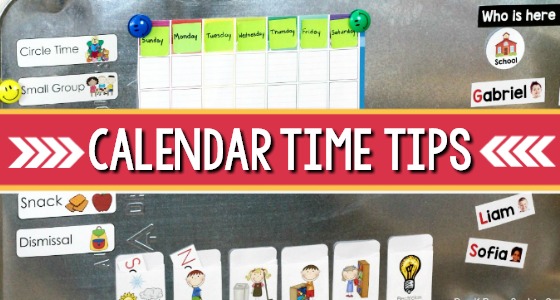
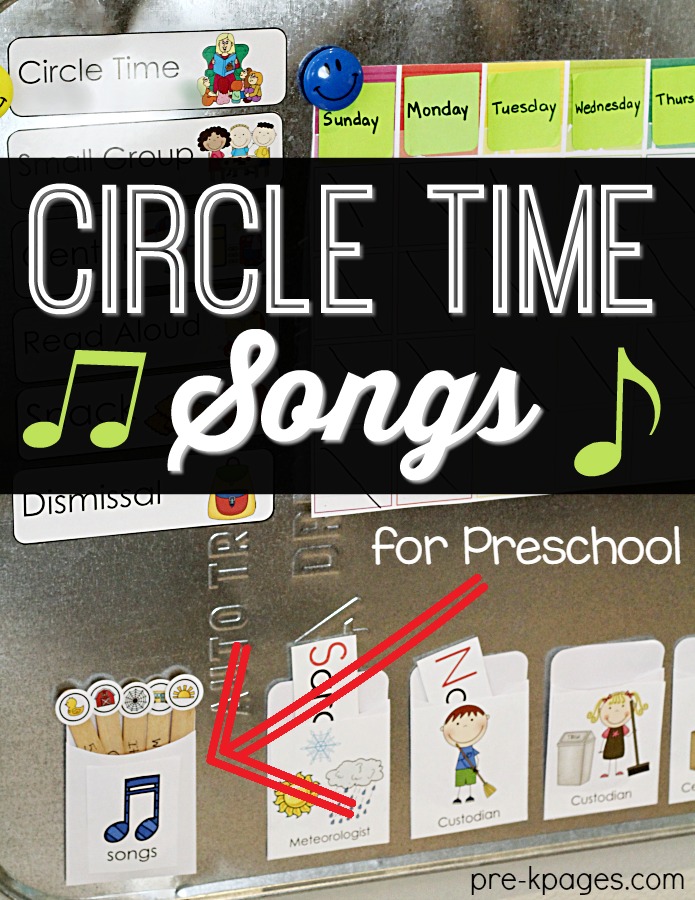
Above you can see our Classroom Helpers chart in action. The chart is made with library pockets attached to the magnetic oil drip pan with magnets. Each week, the student’s name cards are moved to a different pocket. You can also use popsicle sticks with the children’s names written in permanent marker if you prefer.
You can have one job per student, or just a few depending on your needs or your program. I typically assign each student one job for an entire week.
Using a Picture Schedule in Pre-K
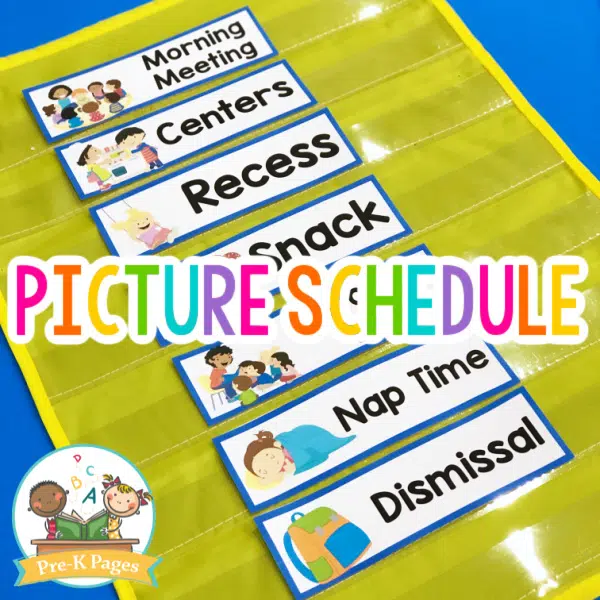
My first tip is to always use a visual picture schedule. You can see our daily schedule above. I use an oil drip pan for my calendar and circle time area. The lightweight pan is attached to the wall with Command Strips.
A picture schedule will help you create smooth transitions by giving your students a visual reminder of what is happening or will happen next in the classroom. You can learn more about how and why to use a picture schedule HERE.
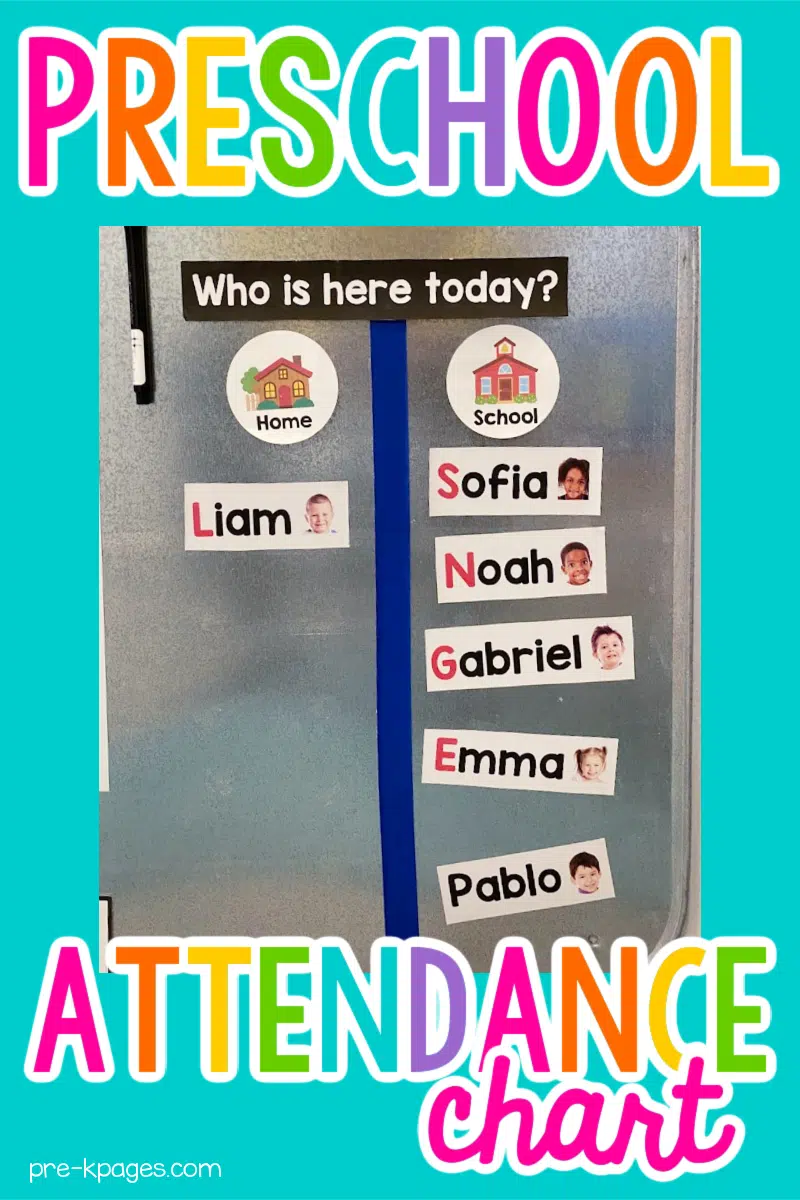
Attendance Chart
When the children arrive, first they locate their name card, seen here printed on Avery Magnetic Sheets, and then place it on the graph to indicate they are here. You can choose a child to retrieve the name cards of the absent students and place them on the graph under the picture of “home.”
During our Calendar or Circle Time we count the number of children who are present and the number of children who are absent using the name cards on the graph. Although it might seem very simplistic, this activity is actually providing kids with an introduction to data analysis skills. When kids have the opportunity to participate in daily graphing activities they are developing important math concepts such as more and less, how many, how many more and so much more! These concepts are the basis for developing number sense.
Calendar Time in Pre-K
Calendar time in Pre-K and Preschool is a long held tradition that many teachers and children adore. While the research points us away from calendar time, many schools still require teachers to incorporate calendar into their daily routines.
Something I noticed about the calendar curriculum our school mandated is that the number line it included seemed to be more effective for my students.
The number line (or linear calendar) helped my students better understand that each day was one more than the last – as opposed to the traditional calendar grid. This linear calendar follows a left to right progression, without any line breaks and return sweep like a traditional calendar grid. Each day a new number is added or flipped over on the linear calendar to create one more.
This is when my thinking around calendar time started to shift. If you’re wondering what to do instead of traditional calendar time, try a linear calendar instead.
Making Calendar Time Part of Circle Time or Your Morning Routine
If you’re wondering how long your calendar time should be or even when to teach it, then you’re not alone! Many struggle to find the right balance, but I’m here to help!
How Long Should Calendar Time Be?
Of course, it’s always important to remember that the typical attention span of young children is 2-3 minutes per year of their age.
If you’re doing a whole group activity, such as calendar or circle time, remember that the total length of time you spend in group should be broken up into active and passive activities.
It makes sense that the time you spend reviewing the calendar during a whole group lesson should be no more than 2 minutes tops.
This allows you to balance the time spent in whole group between sitting and music and movement.

Letting Go of Traditional Calendar Time
Here are some of the reasons why traditional calendar concepts such as yesterday, today, tomorrow, the date, days of the week, months of the year etc. are not best-practice in the early childhood classroom:
- Children learn from the concrete to the abstract, time is an abstract concept.
- The concept of time, such as 2 weeks from now, next month, or next year are abstract concepts that most children develop much later, far beyond the preschool years.
- Our time together in the classroom is short, to make that time as meaningful and productive as possible it is not in the children’s best interests to sit through traditional calendar routines.
For even more ideas, Karen from Prekinders has some fantastic information about how she transformed her calendar time to be more meaningful for her students. You can read all about how she did this HERE.
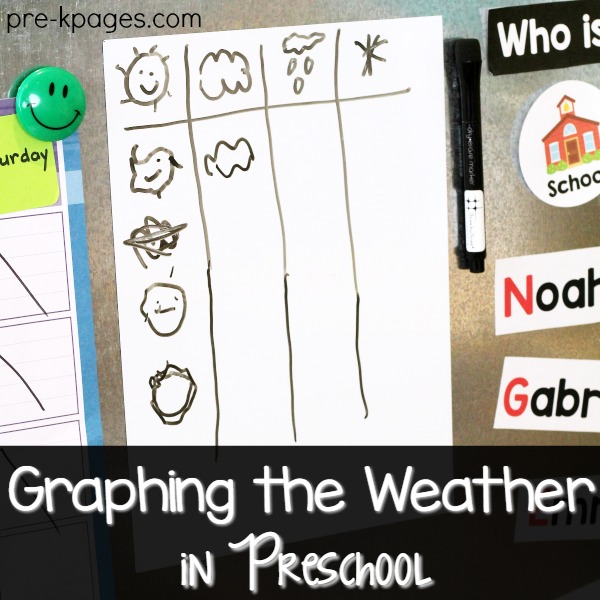
Graphing the Weather in Preschool
Graphing the weather can be exciting for Preschoolers! You can do this quick activity with kids during your calendar time, or even during math or science since it incorporates both skills.
We have a weather helper who looks out the window to report the weather, then draws a picture on this simple dry erase graph. You could also sing a fun song about the weather at this time.
Because time is an abstract concept for young children, you might consider graphing the weather for just one week at a time. You can have the same types of discussions for the weather graph as you did for the attendance graph. Another way to create a graph is with regular paper and markers.
The dry erase area was created by placing a sheet of dry erase contact paper on the oil drip pan.
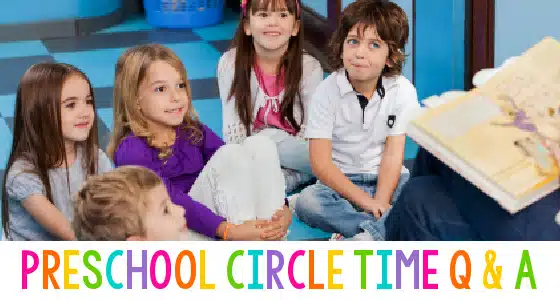
Q&A
“It’s my opinion that we are not giving enough credit to the intelligence of most four to five year- old children. They can learn much more than we think they can.”
Answer: I couldn’t agree more! You’re absolutely right, they can learn much more than we think they can. It’s really more about how they learn these things. I’m all for teaching concepts to young children in ways that are meaningful to them.
“My kids love learning the calendar and miss it when we don’t do it. I really don’t see this as a problem.”
Answer: I’ll address the first part of this comment first: “My kids love learning the calendar” part. My nephew really loves Cheetos! When he was three years old, his father caught him standing on top of the stove in the middle of the night trying to get to the bag of Cheetos hidden in the cupboard. He will do anything to get Cheetos. In fact, he would eat them for breakfast, lunch, dinner, and snacks if his parents let him. But his parents don’t let him do that because they want him to have a healthy, balanced diet. They’re the adults and they’re doing what’s best for his development. My point is: Teaching something because our students like it isn’t a trait of a professional educator. Instead, we can look for more authentic ways to teach counting, shapes, numerals, etc… that don’t take time away from what really matters in the classroom, which is play.
Now, for the second part of the comment: “They miss it when we don’t do it.” Dimitris Xygalatas, an anthropologist and cognitive scientist at the University of Connecticut, says that human brains are designed for pattern-seeking, in order to help us make sense of the world. When we aren’t able to find patterns, we can experience stress. Our mind craves regularity and routine to fight off anxiety. Young children crave routine, it helps them feel in control. So it makes sense that they enjoy the routine of calendar time. I never said kids didn’t like calendar time, my point is that it’s not the BEST use of their time in the classroom.
“The calendar in my opinion is so incredibly useful and important to early mathematics. This is how many of my students rote and back count what comes before and after with numerals, days, months.”
Answer: Can rote counting and numerals be taught through calendar time? Yes, they can. But is the only way to teach these skills calendar time? No!
“The song memorization will help them in the long run… Even first grade.”
Answer: I agree that music is a fantastic way to teach concepts to young children. There’s plenty of research that supports the use of music in the classroom for many different reasons. However, nowhere in the standards does it say that four year old children should say the names of the days and months in order from memory. So singing the days of the week and months of the year songs isn’t as helpful as you might think.
“My own child learned the days of the week since Saturday was the only day he was permitted to play an hour of video games.”
Answer: This is the perfect example of learning something in context. He was highly motivated to learn when Saturday was, and because of this motivation he learned the days of the week. If you have a big event coming up at school that your students are looking forward to, then a calendar (or linear calendar) can be a great tool to use to make it meaningful and track the passage of time until D-day.
“I do the linear calendar – should I introduce them to a traditional calendar soon? I know they use a traditional calendar in kindergarten. What should I do? Stick with linear or start introducing traditional calendar soon?”
Answer: Every minute that your students spend playing with each other, talking, and singing is exponentially more beneficial to them than sitting them in front of a calendar. So no, I wouldn’t do that.
“When [children] do calendar they’re counting, patterning, identifying colors, learning spatial concepts, socially interacting etc…”
Answer: Counting, patterning, identifying colors, learning spatial concepts, and socially interacting can be done in a wide variety of ways – you don’t need a calendar to do these things.
“We use calendar [to learn] about holidays, classroom events, weather etc… There are fun jobs associated with it like moving the day of the week marker to the next day, putting a sticker on the weather board after looking out the window, and deciding what their weather prediction was for the day…all of it was part of our classroom community, they loved it, and it was totally age appropriate for 3-5 year old [children].”
Answer: I agree that having a whole group time, circle time, or morning meeting — whatever you want to call it — is very necessary and not only a great way to start the day, but also a critical component of a high-quality early childhood experience. No arguments there. However, you can still learn about classroom events, upcoming school holidays and weather without a traditional calendar. You can have a helper move the marker to the next section of your daily picture schedule or the next number on the linear calendar.
Free Editable Daily Schedule
When preschoolers have a predictable and consistent daily schedule in place and they know what your expecations are for each upcoming activity, they feel safe and secure and are ultimately more willing to learn.
I’ve taught both full and half-day schedules and I’ve included free editable templates of both types for you here. To have the editable schedules emailed to you, simply fill out the form below.
Teaching Trailblazers
Circle time is only one small part of your preschool day. The best place to get all the support you need is in the Teaching Trailblazers. We have many printable lessons and on-demand video trainings to help you be the best teacher you can be! If you want to get on the waiting list for the Teaching Trailblazers, do it soon so you don’t miss the next open enrollment period!