


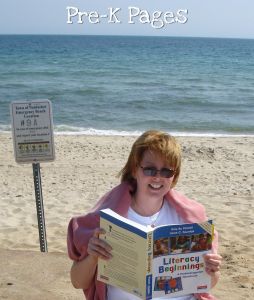
Up until this point Literacy Beginnings felt like an introduction, now I realize that the authors were just setting the stage and we are getting into the real content. This is where our real early literacy journey begins!
Essential Learning Experiences
In this section the authors provide a detailed outline of each of the daily activities. Parts of the day like circle time, literacy centers, choice time, library time, and writing time are explained in detail.
Interactive Read Alouds and Shared Reading Explained
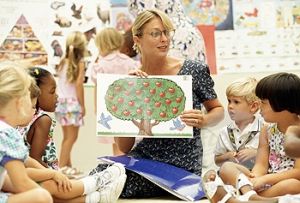
During an interactive read aloud the teacher and students talk and think about the text together. Questions like “What do you think will happen next?” “Why do you think that?” and “What did you notice on this page?” are good ways to get students to not only talk and think about the book but also explain their thinking. This also provides oral language practice which is good for all young children; especially students who are at-risk or second language learners.
What’s your favorite interactive read aloud? Mine is No David! By David Shannon.

During shared reading the teacher and children read in unison from a big book or chart with large print that can be easily seen by all students. Shared reading allows children to practice early reading behaviors (concepts of print). Make sure to check out their list of 5 tips for reading time.
I found this quote about reading very interesting:
Being read to is a familiar activity for most prekindergarten children and a beloved one for all.
This statement may be true later in the school year or perhaps on the first day for some of you depending on where you work. I have always worked with at-risk students and English Language Learners and typically my 4 year old students have not been read to before they enter my class. When you’re a parent who struggles to pay the rent, buy food, and clothe your child books are often considered a luxury. I have to pull out all the stops to show my students how to respect, value, and love reading books. They might leave my classroom with a long list of favorite read alouds but it’s a process getting there every year. I usually start day one with “This is a book and this is what we do with it.”
Do your students come to school with prior knowledge of books?

Library Time
This is my favorite part of Chapter 5 because it is something many teachers struggle with and I enjoy helping teachers so it’s a win-win! The authors recommend having books in labeled tubs or baskets by category.
“Colored dots on books and tubs will help children put books away” (Ch. 5 pg. 61)
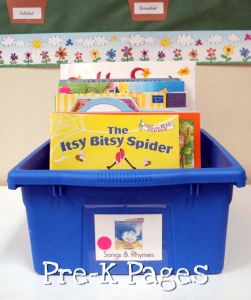
Eureka! I’ve always had my classroom library organized this way so it felt really good to see in print. This method makes sense and it’s easy for young children to grasp if you take the time to introduce and model at the beginning of the year.
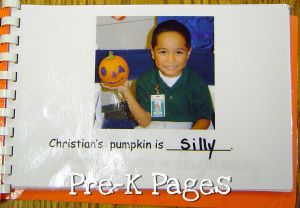
The authors also recommend having books in your classroom library that you have read to the class in addition to a selection of books written by the children. These are two of the most important ingredients to a successful classroom library in addition to a good organizational system. I would add that class books including the student’s pictures can also provide great motivation to read. Often my students who do not normally choose to visit the classroom library will go there just to “read” books with pictures of their friends.
What classroom library tips do you have?
Shared and Interactive Writing
Shared writing is when the teacher acts as scribe but the children participate in the writing process by answering questions posed by the teacher or offering their thoughts on certain aspects of the piece such as how a letter is formed, what sound they hear etc.
Interactive writing is similar but the teacher occasionally “shares the pen” with the students when it is appropriate. The children do not write the entire text independently, they write a letter or punctuation mark here or there with support and encouragement from the teacher. I’m not going to go into detail on this section because there is an entire section of the book on this topic starting with Chapter 15.
Do you use shared and interactive writing strategies in your classroom?
Phonemic Awareness, Phonics, and Word Study
The authors provide suggestions for activities that will promote phonemic awareness and letter awareness as well as specific materials. The importance of using student names to facilitate alphabet learning is mentioned. Starting with Chapter 19 this topic will be covered in depth.
Sample Schedules
In this section the authors offer two sample schedules, one for full-day and one for half-day programs. I like this quote and I know from experience that it is true “Children are more comfortable, relaxed, and empowered when they know what to expect each day” (Ch. 5 pg. 65) You can see my sample schedules here.
Circle Time
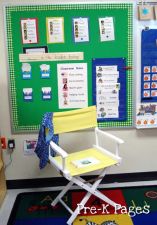
In this section the authors offer suggestions for a successful circle time with the overall message being to keep it short and sweet. I have a slightly different opinion about classroom helpers.
Communicating with Families
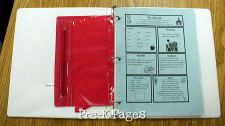
I agree wholeheartedly with most of what the authors had to say in this section but I felt it was aimed more at private or affluent preschools. This is an area I have worked on improving during my years in the classroom; I have discovered what works and what doesn’t with at-risk and ELL populations. What doesn’t work for my parents is the very well written but long-winded sample letter given in the book. My parents would be very overwhelmed by all the text and therefore not read it. What does work for my parents is a weekly newsletter that is broken up into short segments, each portion illustrated with a picture to help with comprehension. I find my newsletters are just as effective with my specific population as long letters.
The delivery method of information is also another obstacle for many teachers; let’s face it, most papers disappear into backpacks and are never to be seen again. This is why I use organizational binders in my classroom. I have had great success using organizational binders and my parents are usually well aware of what is happening in the classroom. Of course, if your parents have access to the internet, e-mail, and Facebook those are also great delivery methods. I believe that having informational parent nights, home visits, and conferences at least twice a year are also extremely important for strengthening communication with families.
How do you communicate with families?
The messages in Chapter 5 are summarized below:
- Planned activities that engage the intellect, curiosity, and imagination of children are essential.
- The daily activities should be organized and predictable but consistently provide new and interesting content based on children’s interests and abilities.
- Opportunities for daily literacy learning are essential. Activities such as visiting the library, phonemic awareness, and reading and responding to literature are essential components of the daily routine.
- Establishing a framework for language and literacy learning will be most helpful.
- Consistent communication with families about children’s literacy learning is vital.
What are your thoughts about Chapter 5? Leave a comment below! If you write a response on your blog, be sure to link up to the Linky party below. Chapter 6: The Critical Role of Language in Learning will be hosted here at Pre-K Pages so stay tuned!