

Have you ever wondered how you’re going to get to everything you’re required to “teach” by the end of the school year? Been there, done that. It’s a delicate balance between teaching the requirements while also trying to honor how young children learn best – through hands-on experiences that are fun and playful. You also have to consider each child in your classroom, which is sometimes way too many to teach effectively. So, what’s a teacher to do?
Here’s the way I have found to be most successful when it comes to managing literacy centers and small groups in my classroom. This method allows the teacher to target instruction directly through fun, hands-on experiences, while also managing a large class.
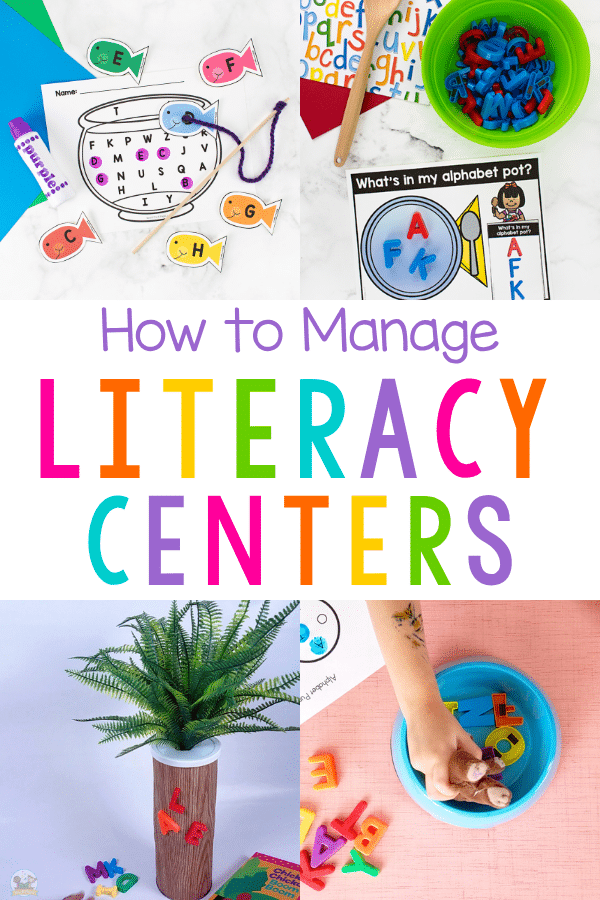
Literacy Centers Management
Different methods of literacy center management work for different teachers. It all depends on what you are most comfortable with and what your program requirements are. There is no one “right way” to manage centers, you should choose the method that works best for you, your students, and your program.
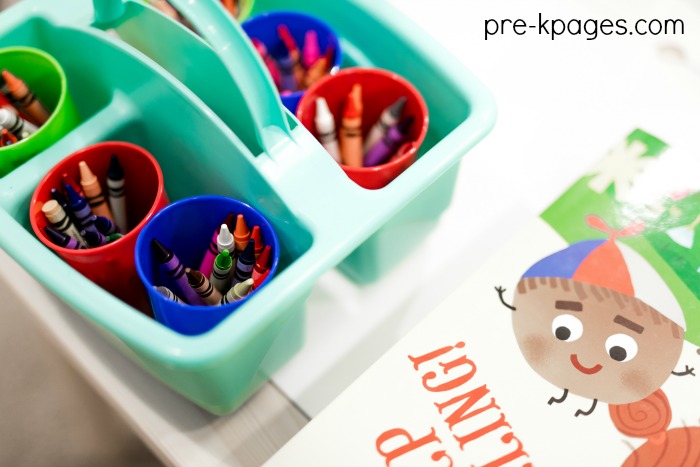
In my classroom there are 4 tables, each table is color coded and seats six. The tables themselves are not colored, they are distinguished by the color of the supply caddy on the table. You can assign students to a color coded table for small group activities. I call these “table groups.” Students can choose which chair they will sit in at that table.
If you have less than 12 students you probably don’t need to follow this method.
Grouping Students for Literacy Centers
For literacy centers, you can group students by ability levels, this means that your small group activities will also be ability grouped. For example, you may place all of your students who can identify only 5 letters or less at the yellow table, all students who know more than 10 letters are assigned to the red table and so on. You will need to test your students to determine their levels. Your color table groups remain the same for math centers, or you can adjust them according to your assessment data.
What do the students do during literacy centers?
Each table has a small group activity students will do each day. The activities all have a hands-on element and are designed to be playful and fun to increase engagement and learning.
Once the students have completed their assigned activity, they are free to choose any of the designated literacy areas in the classroom including the literacy center.
There are 4 assigned activities per week, one per table. The students rotate to a different table each day to complete a total of 4 assigned activities per week at literacy centers. Friday is catch-up day or free choice.
Literacy Center Example
Here is an example of what your literacy small group activities might look like:
Monday:
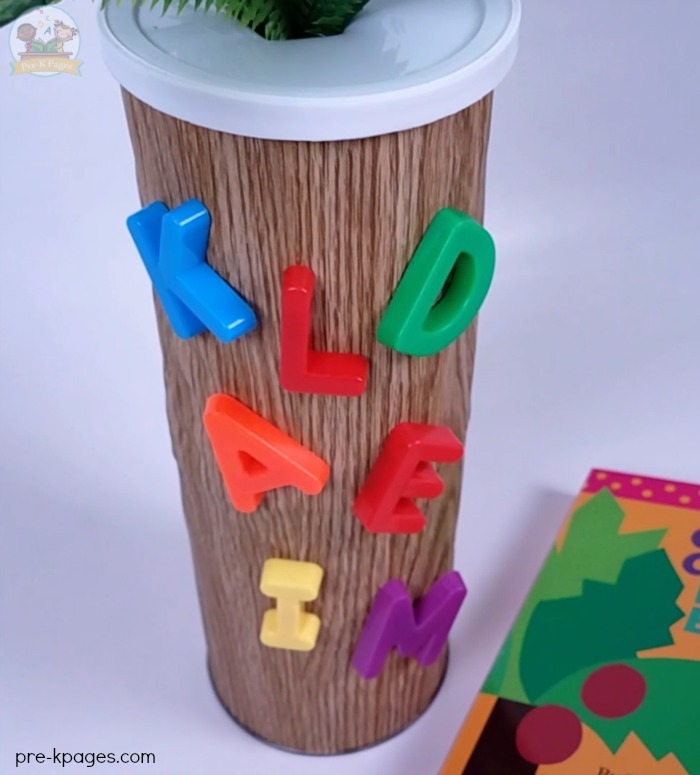
- Red group @ red table- Chicka Chicka Boom Boom tree activity
- Blue group @ blue table- T-chart magnetic letter sort, upper vs. lowercase letters
- Yellow group@ yellow table- curvy vs. straight magnetic letter venn diagram sort
- Green group@ green table- Puppy Chow– letter identification game
Tuesday:
- Red group @ blue table – T-chart magnetic letter sort, upper vs. lowercase letters
- Blue group @ yellow table- curvy vs. straight magnetic letter sort Venn diagram sort
- Yellow group @ green table- Puppy Chow– letter identification game
- Green group @ red table- Chicka Chicka Boom Boom tree
And so on…
What does the teacher do during literacy centers?
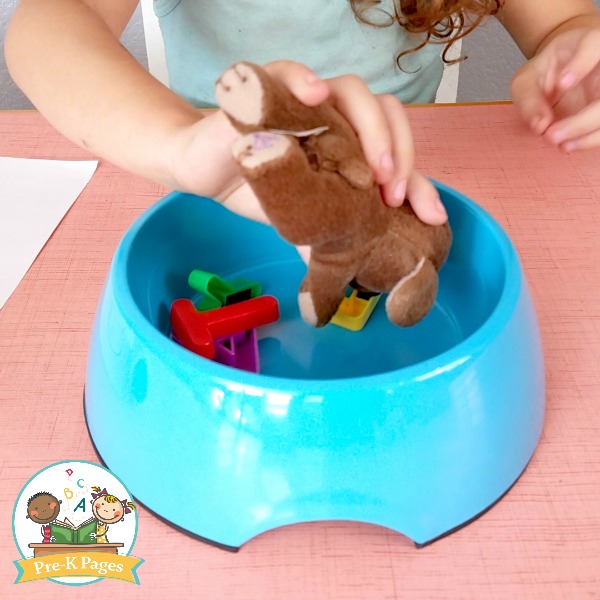
You can work with one group and supervise the other, while your assistant (if you have one) supervises the other two groups. If you are working with a group that is still learning letters and they have the Puppy Chow game, they will examine each letter they pull out of their dog food bowl and then try to match it to a letter mat, then say the letter name etc.
While you’re working with that group you are watching another group closely as they sort the curvy and straight letters. Your assistant is on the other side of the room sitting with one group and watching the other closely and interacting with the students just like you are.
How Long are Literacy Centers
You can implement 20-30 minutes of independent literacy practice each day. Of course, in the beginning of the year this time is much shorter due to limited attention spans, but usually ends up at about 20-30 minutes by the end of the year. Here is an example of our daily schedule.
What types of activities do you have in your literacy center?
You may find these pictures and suggestions for items to put in your literacy center helpful.
How to Organize Literacy Center Activities
To organize your weekly literacy activities, a milk crate has been successful for me. Inside the crate, you can place 4 hanging files. Each hanging file includes a different colored file folder, one red, yellow, blue, and green. Each folder matches the color of your table groups. Then, you can put the assigned activities for the week into the corresponding files.
Organizing Literacy Centers
Using the example of activities given above, you can place the t-charts in the blue folder with a bag of magnetic letters, the Venn diagrams in the yellow folder with a bag of magnetic letters etc. If the item or items you’re using for an assigned task are too large to fit in a folder simply write the name of the item(s) and stick a post-it note inside the folder to remind yourself, your assistant, or any subs exactly what you’re doing at each table and which materials are needed. To prepare for the next week, on Friday you can remove the activities from the week and replace them with the activities for next week’s centers.
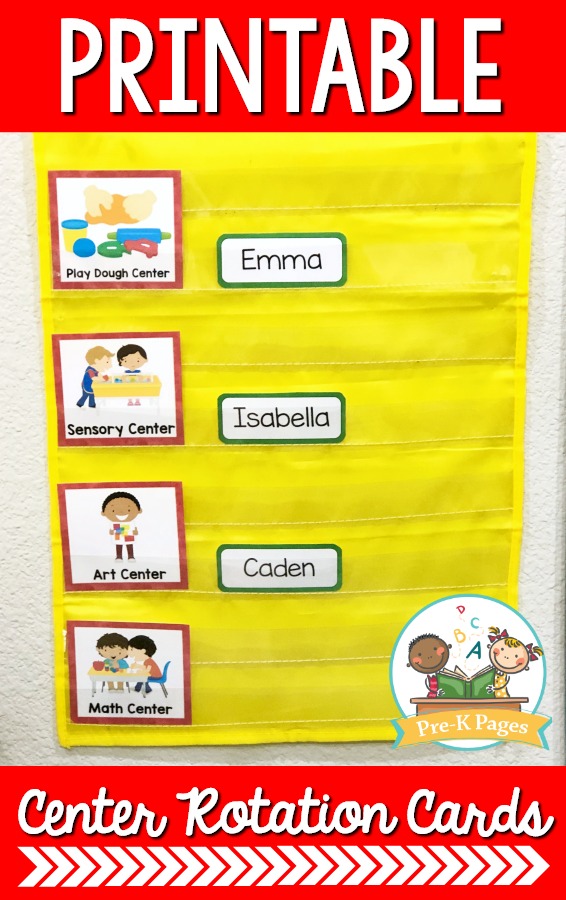
Literacy Centers: Rotation Chart
How do you keep track of who goes where each day? Here’s a picture of the pocket charts and cards you might use to create a visual representation of where students should go for literacy, math, and choice centers. There are four pocket charts, one red, yellow, green, and blue. The cards pictured above are included in the Center Rotation System Packet.
Student Name Cards
The border around the student name cards match the color coding of the tables. Next, the name cards are placed in each pocket chart to indicate the table students will visit for literacy centers. For example, if Emma, Luis, Sophia, Aiden, and Isabella are all in the blue group, you would place their name cards in the blue pocket chart on Monday to indicate that they should go to the blue table for literacy centers. Then, on Tuesday you can move their name cards to the right and place them into the next pocket chart. For example the blue color group would go to the blue table on Monday, then the red table on Tuesday, the green table on Wednesday, and the yellow table on Thursday. Fridays are free choice.
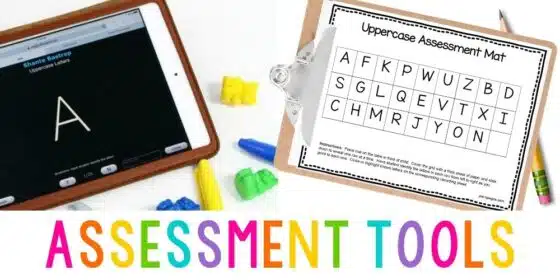
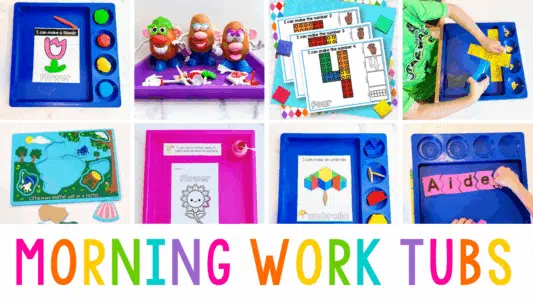
Here are some of our most popular alphabet activities for literacy centers.
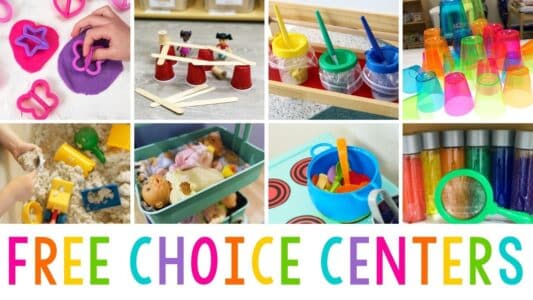



What is the puppy chow game?
Here’s a link to the Puppy Chow Game https://www.pre-kpages.com/alphabet-puppy-chow-game/
What are the assigned activities? Are they the literacy center activities?
Yes, you can find many of the activities we use for literacy centers here: https://www.pre-kpages.com/products/
How do you organize your activities throughout the year ? Do you have color coded tubs for all of the blue activities, green activities, etc.? Like what do you do with the previous week’s activities when you switch it to the new week’s activities? Thank you!
Good question!The items used during literacy centers are returned to their places at the end of each week. For example, the Chicka Chicka Boom Boom tree is housed in the ABC/Literacy Center. The magnetic letters go into a nuts and bolts drawer. If an activity is thematic, for example, fall related, then it goes into the fall theme box. I hope that makes sense!
Good morning,
I am just clarifying; you have four groups that are ability based performing specific teacher directed activities? When the students complete the activity, do they go to a free choice center? Do you only have the one rotation of students per day at the tables? I would love to implement something like this in my classroom. My district wants us to see three to four groups a day. This past year my kiddos rotated throughout the room and I pulled groups. My kids eventually got it but I always felt they were not getting enough playtime and I wasn’t sure if it was DAP. I would love to see a video of how you implement this in your classroom. I am a visual learner and I have to see it to understand it. Thank you so much for all that you do!
Hi Kelly,
Yes, you are correct. I have 4 groups that are ability based performing specific teacher directed activities. Two of the activities are monitored by adults, one with myself and one with my assistant. After they have finished, they have free choice from our literacy centers, such as classroom library, listening, pocket charts, ABC center etc. The students only do one teacher directed activity at the table each day. By Friday they had engaged in each of the 4 activities and therefore have free choice on Fridays.
One more question about the way you have the groups set up. Do the students sit at their color table throughout the day? Or only during literacy centers?
I’ve it done it both ways before, it’s really up to you. Typically, they are in their color groups for literacy and math center activities as well as writing.
If you have 5-6 students at each table for the literacy and math centers with one activity to complete, does that mean you have 5-6 of the same activity for each one to do? Seems like you would have to or otherwise they would be sitting there waiting their turn. Which wouldn’t work…
yes, that’s where the small group literacy and math activities from all the thematic bundles come into play.