
A good pre-K or preschool curriculum is an important part of having a high-quality early childhood program.
What Should a Preschool Curriculum Include?
If you’re looking for information about what a child should learn in pre-K, you’re in luck! In this post you’ll find the most common skills and concepts taught in Pre-K programs throughout the united States.
Although these skills are addressed and introduced, it doesn’t mean pre-Kindergarten students are expected to master these skills before moving on to the next grade level. All young children learn these concepts and skills at their own individual pace, when they are ready.
Hands-On Learning Experiences
Young children learn best through hands-on experiences that incorporate engaging, high-quality picture books, catchy songs and rhymes, and fun games. These types of activities encourage playful learning and allow them to better connect with the expected educational goals.
What Should Pre-K Children Learn?
When you’re writing your lesson plans, it’s important to ensure that you incorporate the concepts and skills your students are required to learn into your lessons. If you need help figuring out which skills to teach when, you can get access to our free curriculum pacing guide HERE.
What to Look for in a Preschool Curriculum
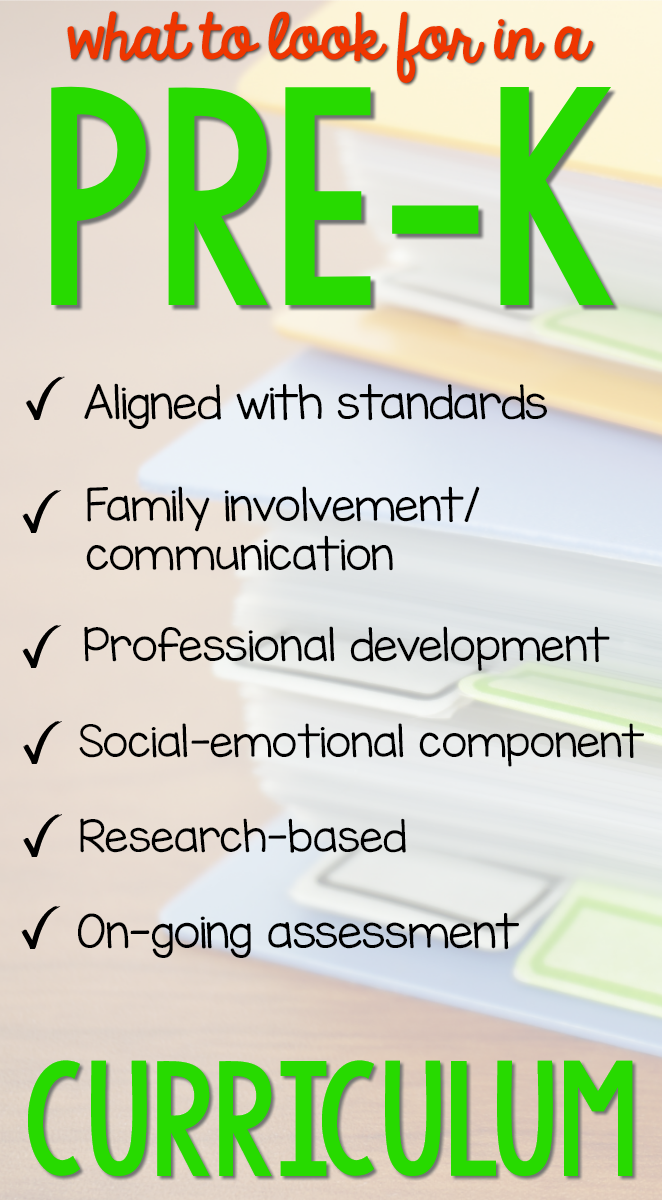
It doesn’t matter which preschool program you teach in; a high-quality Pre-K curriculum includes the following components:
- Language Arts/Literacy
- Math
- Science
- Social-Emotional Learning
- Fine Motor Skills/ Writing
- Assessment
- Training
A good preschool curriculum lays the foundation upon which all future learning is built, so it’s extremely important to choose the right one.

Pre-K Literacy Curriculum
In a high-quality Pre-K Literacy Curriculum, the literacy and language arts outcomes for children in Pre-K (4 years of age) should include the following:
- Enjoys looking at books
- Listens to and answers questions about a story (via read-alouds that utilize high-quality children’s literature)
- Retells familiar stories in their own words from memory (fairy tales and nursery rhymes)
- Answers questions about a story
- Recognizes environmental print
- Understands basic phonological and phonemic awareness components (alliteration, rhyming, syllables, identifies phonemes)
- Recognizes and identifies uppercase and lowercase letters of the alphabet
- Understands basic concepts of print (left to right progression, top to bottom, words, pictures, one-to-one correspondence)
- Has strong visual discrimination skills
- Holds a pencil, marker, or crayon correctly (handwriting skills and fine motor skills)
- Recognizes their name and writes first name to the best of their ability
- Draws pictures and tell about their stories and experiences
- Writes marks, letters, or letter like symbols to communicate thoughts and ideas
Pre-K Math Curriculum
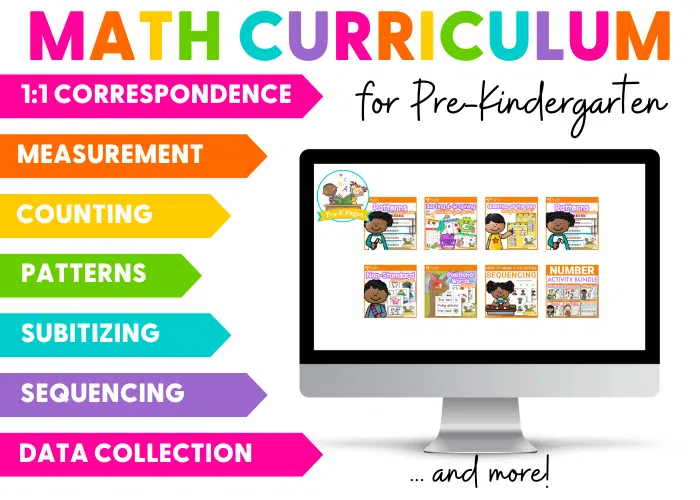
A good Pre-K Math Curriculum has math outcomes for children who are 4 years old that include the following:
- Counts with one-to-one correspondence up to 10
- Identifies more, less, or same
- Orally counts numbers 0-20 in order
- Identifies without counting objects up to 10 (subitizing)
- Recognizes and identifies numbers 0-10
- Identifies more, less, or same
- Recognizes, names, and creates common shapes
- Uses positional words to identify location (over, under, above, on, beside etc.)
- Understands and uses non-standard units of measurement
- Capacity
- Heavy and light
- Night and day (in relation to passage of time)
- Sorts objects that are the same or different
- Basic data collection (graphing, tally marks etc.)
- Can recognize, identify, create, and extend patterns
Pre-K Science Curriculum
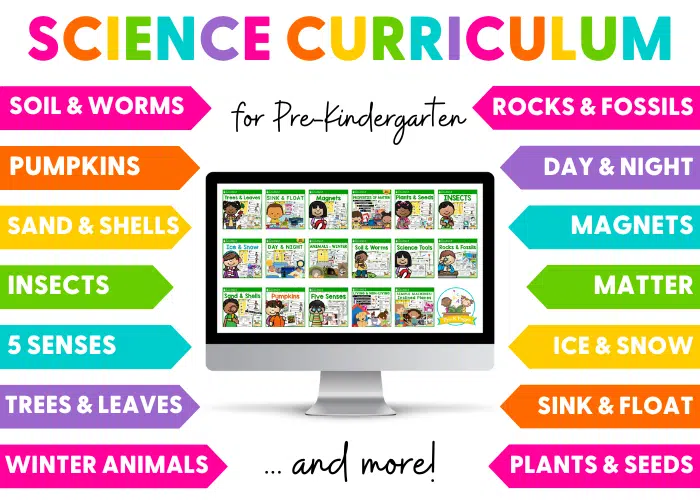
The science outcomes in a Pre-K Science Curriculum designed for children 4 years old should include the following:
- Investigates, describes, and discusses energy (light, heat, and electricity)
- Identifies and use simple science tools (balance scale, hand lens, measuring stick or tape etc.)
- Hot and cold
- Force and motion (magnets, ramps)
- Needs of animals (food, shelter, water, air)
- Needs of a plant (water, soil, air, light)
- Life cycles (seeds, plants, animals, insects, people)
- Seasons (fall, winter, spring, summer)
- Environments and habitats
- Earth (rocks, soil, sand)
- Sky (sun, stars, moon, planets)
- Weather (clouds, wind, rain, snow)
- Understands importance of caring for the environment (recycling and conservation)
- Can observe, explore, predict, collect and analyze data
Pre-K Curriculum: Social Skills
Appropriate social skills for children who are 4 years old include:
- Demonstrates understanding of how to care for classroom materials (clean-up)
- Carries out classroom helper jobs
- Can share space and materials with others (follows a center time routine)
- Can identify and describe their own feelings and emotions
- Has been introduced to and seeks out specific tools or techniques to help regulate emotions (yoga, calming techniques etc.)
- Can interact with classmates appropriately and makes friends independently
- Understands that others have emotions that may be different from their own (empathy)
- Cares for own personal needs (toilets independently, can put coat on, zip, button, blows nose independently etc.)
- Can communicate their own wants and needs verbally
Language and Communication Skills: Speaking and Listening
- Understands and follows two-step and three-step directions
- Uses words to describe people, places, and things
- Understands simple conversational rules
- Child has a speaking vocabulary of 3,000-4,000 words
- Understands non-verbal conversational cues
- Speaks in complete sentences of four or more words
- Understands instructional language (stand up, sit down, line up etc)
If you suspect your child may have a speech or language delay, or any learning difficulties, you should contact your local school district immediately and request a free evaluation for your child. Public school districts in the U.S. are required by law to provide screening and evaluation for children ages 3 and up. The sooner any delays or difficulties are identified, the more quickly your child can begin receiving services. Do not wait until your child starts public school to make this request, it’s always better to do it before your child formally starts school.
If your child is already enrolled in a public school, ask your child’s teacher for guidance in requesting services.
Homeschool Preschool Curriculum
While the Pre-K Pages curriculum isn’t designed specifically for homeschooling, there are many homeschoolers who choose to use our curriculum to ensure their children receive a high-quality early childhood experience.
Childcare Preschool Curriculum
Our curriculum was developed with 4-year-olds in mind, although we do have many 3 year-old teachers who use our materials for their students who are developmentally ready for more.
What’s NOT included?
-
- Worksheets – position statement
- Traditional Calendar
- Behavior rewards such as tokens, stickers, tickets, pom-poms, desk pets, or behavior charts.
- Letter of the Week – position statement
- Focus Walls – position statement
Who uses this curriculum?
-
-
-
- Speech therapists
- 3 year-old teachers
- Pre-kindergarten teachers (4 years-old)
- Kindergarten teachers (5 years-old)
- TK (Transitional Kindergarten) (4-5 years-old)
- JK (Junior Kindergarten (4 years-old)
- Senior Kindergarten (5 years-old)
- Head Start teachers
- Instructional Specialists
- Instructional Coaches
- Childcare Teachers
- Homeschoolers
- … and more!
-
-
Free Editable Daily Schedule
There is so much to teach in a school day, how do you fit it all in? Well, I’ve taught both full and half-day schedules and I’ve included free editable templates of both types for you here. To have the editable schedules emailed to you, simply fill out the form below.